<body><script type="text/javascript"> function setAttributeOnload(object, attribute, val) { if(window.addEventListener) { window.addEventListener('load', function(){ object[attribute] = val; }, false); } else { window.attachEvent('onload', function(){ object[attribute] = val; }); } } </script> <div id="navbar-iframe-container"></div> <script type="text/javascript" src="https://apis.google.com/js/platform.js"></script> <script type="text/javascript"> gapi.load("gapi.iframes:gapi.iframes.style.bubble", function() { if (gapi.iframes && gapi.iframes.getContext) { gapi.iframes.getContext().openChild({ url: 'https://www.blogger.com/navbar/6466083?origin\x3dhttp://artlife.blogspot.com', where: document.getElementById("navbar-iframe-container"), id: "navbar-iframe" }); } }); </script>

the art life

"...it's just like saying 'the good life'".

This just in

Friday, February 05, 2010
Just as we posted our roundup of comments from our call for suggestions for influential shows [see below], we received an email from a reader we shall do the favour of calling Sgt. Schultz. Although not exactly what you'd call a "positive" suggestion, the good Sargeant remembers a stoush in the Sydney:

Well, perhaps not influential, but I'd say Tony Bond's Body exhibition at AGNSW rates a mention for the following...

A clear realization that if you really want to see particular master works, go overseas, they're never coming here. Bond's inclusion of prints of artworks he wanted for the show was a pretty stark reminder that even if they could be loaned, they won't come to the outposts. (Perhaps this has changed a little, and perhaps this embarrassing curatorial 'decision' spurred the good museum folks onto lobbying a bit harder and demanding standards that can not really be argued with. Maybe.)

Secondly, Bond's inclusion of a substantial amount of his acknowledged friend Mike Parr's work. The ensuing battle in the SMH instigated by the esteemed critic, between himself, Bond and Parr reached fever pitch. McDonald eventually publishing a fictional fantasy dialogue. Not since (I couldn't really say if before) has arts coverage in Sydney and likely in Australia (with the exception of the Henson Fiasco) been afforded such column inches, a trait more common in the British press. For once, a seriously curated exhibition of contemporary art was given a good going round in the papers. Who cares what was said - it was there. The sensation was not tabloid, it was merely a mutual distaste between the combatants - who in turn fired off by turns intelligent and amusing missives and an editor willing to let it run. If only that would continue.

Labels: ,

Ladies love a nice unicorn

Wednesday, August 05, 2009
"A clever child might argue that the unicorn could exist because it is no more absurd than the narwhal whale. The twisted tusk of the narwhal is what was supposed to grow from the head of the horse known as the unicorn. The centrepiece of a 15th-century Flemish mille-fleurs tapestry in the Victoria and Albert Museum is a unicorn, with a horn exactly like that: a narwhal tusk projects from its forehead, and a heavy tail with flukes, like a whale's, flourishes above its back. The background is studded with symmetrically placed flowering plants, plus the odd exotic game bird. I would give much to know what the tapestried picture means. Are all the featured creatures imaginary? Is the invented world of human fantasy here presented as superior to reality? Without knowing more about the idea of the unicorn, there is no way I can know what I am looking at.


"A horse with a horn is not a contradiction in terms, unless I define a horse as a hornless creature. It makes no odds that a horse has no need of a horn. The narwhal does nothing with its "horn", which isn't even a secondary sexual characteristic because some females have them as well as males. The tusk is actually an overgrown incisor tooth. In theory, horses, too, could start growing a tooth into a tusk and then into a horn. Rhinoceroses have single horns made of modified hair; the mane of a horse could one day develop into a kind of horn. It hasn't happened – as far as we know – but no evolutionist should discount the possibility..."

The eternal fascination of unicorns, Germaine Greer, The Guardian UK.

Labels:

Let a thousand flowers bloom

Monday, July 27, 2009


"When Clement Greenberg developed his canonical account of American-style painting, he identified Jackson Pollock and the other Abstract Expressionists as heirs to early twentieth-century French modernism. China has very distinguished modernists, the great Wu Guangzhong, who was born in 1919, is still painting, but their concerns are too distant for them to play any role in [Karen] Smith’s history. Her avant-garde artists borrow from the West, but it is impossible to map their development onto the history of our artistic development. China really is another world. Mao, the most important political figure, is not easy for Westerners to understand, for though his responsibility for great disasters is acknowledged, he is much admired. Xu Bing, a victim of the Cultural Revolution, still expresses “a strong Maoist art philosophy that art should derive from routine life and should serve the people” [...]

"Nine Lives focuses on artists who mostly remained in China, figures whose careers Smith has followed at a first hand. And so it deserves to be supplemented with her account of Ai Weiwei, who spent the 1980s in New York City. Living there “his response to his own personal experience was to deny China—his roots, his culture and the value system that had been imposed upon him”. But since he returned to Beijing in 1993, and, taking a major role there in serving to inspire Herzog & de Meuron’s planning for the 2008 Olympics, clearly now he is part of the story.

Smith describes Wang Guangyi’s appropriation of Maoist propaganda techniques in Great Criticism Series: Andy Warhol (2002); Geng Jianyi’s laughing faces; Fang Lijun’s images of “the sense of isolation”; Gu Dexin’s decaying red meat and spoiling ripe fruit; Li Shan’s homoerotic images of Mao; Zhang Xiaogang’s deadpan portraits; Xu Bing’s deconstructions of calligraphy; Zhang Peilli’s video showing public social dancing and Wang Jianwei’s, which displays emerging social conflicts. A great teller of this “history that has yet to be set in stone”, her narrative combines marvelous detailed interpretation with suggestive a historical perspective..."

Nine Lives: The Birth of Avant-Garde Art in New China by Karen Smith, and Ai WeiWei by Karen Smith, Hans Ulrich Obrisi, Bernard Fibicher reviewed by David Carrier, Art Critical

Labels: ,

Off The Rails

Tuesday, June 23, 2009
The paltry offerings from Australian art critics sojourning in Italy for the 2009 Venice Biennale have been thus far the usual predictable fare - pithy putdowns for art they have no time for, offering instead a blanket refusal to enage with the subject of the art while making no attempt to parse intention from context. Such is the lot of art critics with travel budgets but lacking a real understanding of contemporary art in the big bad world. Happily, the web offers the work of Jerry Saltz, art critic for the New York Magazine whose latest column is an intelligent and thoughtful disscetion of the problems - and successes - of the Biennale experience:


"Venice is the perfect place for a phase of art to die. No other city on earth embraces entropy quite like this magical floating mall. There are now more than 100 biennales around the world (most of them put together by the same 25 celebrity curators, drawing from the same pool of 100 or so artists); Venice is often called “the most important” of them. The main show of this year’s Venice Biennale is the work of Daniel Birnbaum, a well-respected 46-year-old Swedish critic and curator. His “Making Worlds,” held in the Palazzo delle Esposizioni delle Biennale and in the magnificent Arsenale, attains an enervating inertia of exhibitions and brings us to a terminal state of what we’ll call “the curator problem.” The show, containing the work of 90-plus artists, doesn’t offend or go off the rails. Rather, it looks pretty much the way these sorts of big international group shows and cattle calls now look; it includes the artists that these sorts of shows now include. It’s full of the reflexive conceptualism that artists everywhere now produce because other artists everywhere produce it (and because curators curate it). Almost all of this art comments on art, institutions, or modernism. Basically, curators seem to love video, text, explanations, things that are “about” something, art that references Warhol or Prince, or that makes sense; they seem to hate painting, things that don’t make sense, or that involve overt materiality, physicality, color, or strangeness..."

Jerry Saltz, Entropy In Venice. The New York Magazine.

Image: Still from Steve McQueen's Giardini. Photo: Courtesy of: Courtesy Marian Goodman Gallery, New York / Paris; Thomas Dane Gallery, London and The British Council. via New York Magazine.

Labels: ,

Well Fancy That #17: It's A Conspiracy!

Monday, February 02, 2009
"Here is an exhibition of an important contemporary Australian artist and an aesthetic sensibility that is the antithesis of everything that exhibitions such as Optimism in Brisbane would have us believe is the essence of the art of our time.

"Cressida Campbell seems never to have looked over her shoulder to see what other people are doing, or tried to second-guess trends and institutional taste. She has simply concentrated on making her subtle and distinctive woodblock prints, and has gradually become one of those artists that collectors wait in line to acquire.

"She has never worried about the tribe of curators and catalogue-essay writers and the art establishment has consequently ignored her. The paucity of her bibliography is striking, especially considering the quantity of verbiage heaped on far less significant artists. Curators have no idea what to make of her: on the face of it, she should have been an outstanding candidate for an exhibition on the theme of optimism, and there was a touch of irony in the fact that she had a commercial show at Philip Bacon's gallery in Brisbane at the same time. But the functionaries of contemporary art are guided by brands and slogans, not by visual appreciation."

Christopher Allen, Happy Days, The Australian, Jan. 31, 2009.

Labels: , ,

Well Fancy That #14

Monday, September 10, 2007
"The Dobell [Prize for Drawing], at the Art Gallery of NSW, is a good case study because it is one of the better prizes: it is well organised and motivated by good intentions. The idea of an acquisitive prize supporting drawing, which many, with good reason, feel to be neglected in our art schools, sounds noble. What could possibly be wrong with it?

"The fact that it is a prize. Precisely because of the competitive situation it creates, the Dobell encourages artists to enter drawings that are bigger, more finished, more conceptually forced than they may ordinarily produce. They can't resist the temptation to tint things up, add another, larger, more expensive piece of paper, to push at the limits of drawing.

"In other words, they are led away from the kind of drawing they habitually do into something performative and tarted up, like a finalist on Australian Idol. And this in turn leads us, the audience, away from an appreciation of the true role drawing plays in their work."

Sebastian Smee, Pencil It In, The Australian, September 8.

Labels: ,

Young Eisenstein

Tuesday, September 04, 2007


Opening scenes from John Berger's Ways of Seeing [1972], from YouTube.

Labels: , ,

Well Fancy That #13

Monday, August 20, 2007
"We all know children need to be educated. But sometimes they don't want to know more.

"They just want to stand back and marvel. Critics, alas, are expected to speak about art like adults, not like children. Once in a while, however, even a critic sees something that makes maintaining the usual front seem pointless.

"I had an experience like this in Venice in June, in a large gothic palazzo, the Palazzo Fortuny, that faces a campo a little back from the Grand Canal. It houses an exhibition that opened in the same week as the biennale and includes work by artists as famous as Pablo Picasso, Francis Bacon, Andy Warhol and Alberto Giacometti. But it has been written about by almost no one. I don't know why. I can only think that those journalists who saw it felt as I did: that here was something that defeated criticism, that was instead something to hold close, to lose oneself in and -- evidently -- to shut up about."

Sebastian Smee, An Elegant self-sufficiency, Review, The Australian, August 18-19, 2007.

Labels: , ,

Well Fancy That #10

Monday, May 28, 2007
"The free-form patchwork of [Kitty] Kantilla's paintings, the sheer delight in mark-making, can, for instance, remind one of Van Gogh's landscape drawings, with their idiosyncratic profusion of dashes and dots applied without predetermined formulas. The trembling lines that fade in and out, meanwhile, can make one think of the hesitant outlines and ambivalent spatial effects of Giorgio Morandi...

[...]

"...[Judith] Ryan, whose curating of the show and catalogue essay are otherwise brilliant, to compare Kantilla's aesthetic to Western minimalism, to Western modernism's interest in grids, and to ideas such as "the integrity of the surface" and the "autonomy of art"; she even speaks of Kantilla's "greatness as a conceptual artist".

"This sort of talk may be reassuring to some, but it makes me deeply uneasy. Art is done a disservice when too much is claimed for it. Elaborate arguments can be made to back the kinds of claims Ryan makes, but in the end, who does it benefit? Why does the art need it? Does it not, in fact, stretch credulity and risk having a counterproductive effect?"


Sebastian Smee, Remembrance of things past, The Australian, May 26-27.

Labels: , ,

Well Fancy That #7

Monday, April 02, 2007
"It took a new method of painting -- outdoors, freely and with loaded, square-tipped brushes -- and a few artists of rare talent to convey the real look and feel of Australia's pastoral landscape, its coastline and its wealthy cities. The method, of course, was imported. It was borrowed from the European tradition of plein-air painting (not, despite the show's title, from French Impressionism as we know it through the art of Monet, Renoir and Pissarro). And although the liberties it took with conventional standards of finish might have seemed deplorable to certain critics in Australia at the time, it was far from avant-garde in world-historical terms."

Moving record of nation's first glimpse at itself, Sebastian Smee, The Australian.

Labels: ,

Well Fancy That #6

Monday, March 12, 2007
"Images of factory farming or the slaughterhouse are rarely seen, not even when we drive through the countryside where farm animals have become less and less visible. The paddocks and fields they used to occupy have been steadily replaced in recent times by conurbations of metal huts or 'food factories'..."

Sebastian Smee, Beastly goings on, The Australian, March 10-11.

Labels: , ,

Well Fancy That #2

Monday, February 12, 2007
"Politics, of course, is catnip to the curatorial team at the MCA. Unless the shows have a high sociopolitical content, they are out of their comfort zone. Consider the program over the past tow years: it has been stuffed full of political, proselytising shows: Destiny Deacon, Rosemary Laing, Interesting Times, Mona Hatoum, Juan Davila, the 2006 Biennale, the 2005 Primavera, Mike Parr and Keinholz. Some of these shows have been excellent. But when one comes hard upon the other, you may easily end up feeling groggy, bullied and disenchanted."

Hip But Not So Happening, Sebastian Smee, The Australian, January 10-11, 2007.

Labels: ,

Unimpeachably Hefty

Monday, November 06, 2006
Kevin Robertson is an artist who lives in Western Australia. He dropped by to leave this comment regarding our recent 25 Predictions for The Future post:

“This is really dire. Apart for being a vacuous piece of writing, I have heard other people quote the artlifes before "drawing is the new video", etc, etc. You are running out of ideas, guys. Well you are only middle class hypocrites/human. You deserve to be judged by your work, and for being so autocratic.”


We are certainly guilty of recycling some of our jokes, especially when they’re being presented in a new context, [such as when we gave a talk at Firstdraft’s 20th birthday and where these non-too-serious predictions were presented], but on the other hand, the comedy rule is that when you tell a joke it gets funnier the more you repeat it, then it’s unfunny for awhile, but eventually becomes incredibly funny. We’re on the upswing here Kevin, so please stick with us. But this accusation of being ‘autocratic’ troubled us, so we decided to look up the exact meaning of the word:

“Offensively self-assured or given to exercising usually unwarranted power; "an autocratic person"; "autocratic behavior"; "a bossy way of ordering others around"; "a rather aggressive and dominating character"; "managed the employees in an aloof magisterial way"; "a swaggering peremptory manner" authoritarian: characteristic of an absolute ruler or absolute rule; having absolute sovereignty; "an authoritarian regime"; "autocratic government"; "despotic rulers"; "a dictatorial rule that lasted for the duration of the war"; "a tyrannical government’” [ Wordnet]


It might be time to just state for the record that we do not recognise the legitimacy of the International Court of Justice, the right of anyone to pass judgment on our past or present activities, the puppets of the invaders or anyone else from “the west” who has led this invasion of our lands, etc, etc. [It’s not much of a defence, but it may be the only one left to us].


Impeccably dressed in Hugo Boss, The Art Life denies culpability in past 'autocratic' rule.


It’s always gladdening to see that even when someone is damning your efforts, they’re also holding out an olive branch in the form of a URL to their own web site. When we wrote that we didn’t like Dr. Daniel Mudie Cunningham’s show at MOP we figured we’d lost a potential friend but now his web site graces our list after he sent us an email requesting to be added. [We’re incredibly happy to link to a site that features pictures of a man with cheekbones so sharp and pronounced that tears would surely collect under his eyes like glistening pools where one might see one's own reflection] In a similar spirit of good natured self promotion, as Kevin Robertson damns us all to hell, he’s left us his web site featuring some lovely work which has been described by Robert Cook as “plotless”. Hoorah! If you’re an artist-critic-curator – or you just you have a web site that you’d like us to link to - just send us an email and we’ll include it on the list.

A few weeks ago we decided to lift our moratorium on reading newspaper art critics. We had somehow strayed back to reading the odd column by The Esteemed Critic and soon we were back on the horse full time. Last Saturday’s column by John McDonald in Spectrum was a completely inoffensive recounting of his recent junket to Singapore. Sponsored by the Singaporean Government’s National Arts Council, McDonald’s trip to take a gander at their first Biennale produced a piece of writing so even and carefully worded that, faster than you could say ‘Sarah Lee’ we’d drifted off into a long, peaceful sleep. No change there. Upon waking we decided to take a look at what Sebastian Smee was up to. You have to wonder what’s going on over at The Australian, completely obsessed as they are with overturning the rule of postmodernism and the oxymoronically demonized spectre of “theory” in the arts. The battle lines rage across education, point and counter point being blasted out with little actual explanation of what the conservative side of the argument is. Smee is their ideological art warrior, leading the charge for conservative values in the visual arts, talking up the legendary status of deeply mediocre modernists like Lucien Freud while writing off the efforts of young Australian artists without even bothering to mount an argument.

Smee’s typical m.o. is to alternate between two modes of writing; hectic, breathless celebrations of greatness or dismissive, trite and misguided pieces on subjects about which he knows very little. Both approaches are usually held up by the ponderous scaffolding of “think pieces”. Here he is from last Saturday in a review of Goddess at the Art Gallery of NSW:

“BREASTS of unimpeachable heft and bounce, bloody garlands of severed heads, a menagerie of wild animals and images of mesmerising spiritual intensity combine to make Goddess, the new show at the Art Gallery of NSW, the greatest exhibition mounted in Australia this year. An exploration of the roles of goddesses in Hindu and Buddhist art, it is one of those rare, transforming shows that should not only excite the public but, with any luck, set ablaze the imaginations and ambitions of local artists and curators, too.”


What do you suppose the editors thought when they came across the word “greatest” in this context? Can you think of the top ten “greatest” shows you’ve seen this year? Or did he just mean ‘best’ shows? And ladies, are your breasts unimpeachably hefty? Storm in a D cup warning! This is just Smee on autopilot throwing out meaningless adjectives as is his want. Nothing to get terribly excited about and nothing really to dissuade you of the view that it’s business at usual at Review. Smee’s recent review of For Matthew And Others: Journeys with Schizophrenia staged at the Ivan Dougherty Gallery and the Campbelltown Arts Centre, is a fabulous example of a critic betraying their prejudices. The review began like this:

“In Australia we have recently developed a strange mania for trying to use art to solve social problems. Why this is, I can't say. Perhaps, wanting to believe in art but being surrounded by relatively little in the way of true greatness (we have no Louvre, no Prado, no Metropolitan Museum) we are eager to find other purposes for it. Or perhaps, when it comes to social and political issues, we are just naive.

Aboriginal art is the classic example of good intentions being funnelled through art towards a higher social and political purpose. But you find the principle at work elsewhere, too. Whenever rips in the Australian social fabric start to show, people look to art - in the form of exhibitions, festivals and so on - to provide a solution. Something like this has happened in the sphere of multiculturalism. And it is happening again in mental health.

As with Aboriginal issues, government policy in mental health has been botched so badly and for so long that it may be no surprise to find people looking outside the political arena for a miracle cure. But why, time and again, art should get the guernsey is beyond me.”


Perhaps Australian’s are naïve – after all, we keep buying the same old newspapers day after day – and perhaps, just perhaps, if we had access to masterpieces by Europeans we’d come to realise that our crazy notion of wanting art to be socially engaged is just foolish. But hang on a second, wasn’t Pablo Picasso’s Guernica, perhaps one of the best known socially engaged works of art ever made, actually in the Prado? So would this not mean then that local, grass roots engagement with social problems in art – say, mental illness – be just as relevant here as it is anywhere else? And could we seriously argue that this “mania” for “turning to art” to “solve” problems is just Australian?

Smee recently made the claim that Tony Tuckson never painted a decent picture in his life. What’s happening over at The Australian is that Smee is getting high on his own supply which, as Tony Montana warned, leads ultimately to self destruction [and having your fortress of critical solitude invaded by gun toting drug dealers]. Freebasing opinions like these suggest the true autocratic ruler of this land resides elsewhere.

Labels: ,

Art Life Security Threat

Thursday, October 12, 2006
The reason The Art Life is a terrorist target is because the terrorists hate who we are, not because of what we do. We have just been going about our business like we always do, and there has been a lot of business to do over the last couple of weeks. We have been re-jigging our publishing schedule so that our bi-weekly blog updates alternate with our bi-weekly radio show and podcast. Since we posted the first of the podcasts last week we’ve had so many downloads and subscriptions that we’re already number 15 in the iTunes Top 20 Art podcasts. Sign up for the bi-weekly update and, who knows, we may even get to number 1 [with a bullet]. This blog has also recently been nominated the 6th most top art blog in the world. It’s a big honour to be recognised, even if it’s in a site we’ve never heard of - Top Ten Sources - but it’s nice to be loved by some even if the terrorists want to release Sarin Gas into our change room .


We were recently in Newcastle for the This Is Not Art festival, which was actually five festivals under the ‘TINA’ umbrella. After getting back from our appearance with Lily Hibberd and Jeff ‘Wrath of…’ Khan talking about art writing and publishing, we received a mysterious anonymous email asking us if we would please write a review of TINA. We would have loved to have seen enough to write a review but unfortunately TINA was the most shambolically organised event we’ve been involved with. The plan was to go to Newcastle the day before our appearance, go to a few events, attend a cocktail party or two, relax by the beautiful Newcastle foreshore, do our talk, perhaps linger for the rest of the day before heading back to Sydney. Sadly, TINA’s promise of accommodation as an offset for the fact we weren’t being paid to be there never happened due to a complete breakdown in communications between Art Life officers and the TINA people. We never had official confirmation we were speaking at the event and had to rely on the website to confirm we were even on. No one told us where exactly we were speaking, no one gave us any information about venues or details of the city – maps and so on - and the only person from the TINA org we saw was its director Marcus Westbury who dropped by to say hi. Compared to others, we had a good time of it. We heard of some people who had been put up in accommodation right next to a Newcastle nightclub, their hotel walls pounding with disco beats until 5am, and others who arrived from interstate to discover their scheduled appearances were listed in the TINA program as having happened the previous day.

The only thing we saw much of in Newcastle was the inside of the fabulous Goldfarb café and the hundreds of Christian youths cavorting in the park opposite the Newcastle town hall taking part in the festivities of the Jesus Make Us Whole Festival [not affiliated with TINA]. People we met who had been in town for a few days and had got down with the laid back organisational ethos said the fest had some great events. Unfortunately, TEAM Art Life had to pack up our robes, get on the bus and head back down the F1 regretting the fact that we hadn’t demanded at least a free cup of coffee for our troubles. As to the review, we can’t help you, but our friend Lauren at She Sees Red has written an excellent account.

Another story that we’d been following with interest lately has been the sudden and inexplicable change of direction in opinion by our good friend The Esteemed Critic. For those of you who don’t recall, we decided some time ago to have a three month moratorium on any mention of the Sydney Morning Herald’s art critic John McDonald. This was because we were heartily sick of him and by just ignoring his boring, pedestrian and highly predictable reviews we were hoping he would go away. Well, we had been putting so much energy into ignoring him that we ended up actually forgetting about him for awhile, and by not reading his reviews and articles, life started to seem so much brighter and happier. Time passed, weeks turned into months, and now it has been – ooh – six months since we even opened Spectrum to see what he had to say. Two weeks ago we thought, oh go on, have a look – and guess what – things had actually changed.

At the end of last year when the whole brouhaha over the future of the National Art School kicked off, we noted here that when McDonald used his column in the SMH to promote the cause of saving the NAS, he was in no position to claim any objectivity in the matter as he was listed on the NAS website as an employee of the art school. It turned out later that “someone” at NAS had taken it upon themselves to list his name there even though he wasn’t on staff. Our questions about the ethical nature of using a SMH column as a soapbox while claiming to be objective was met with a rather rudely worded email from the Esteemed Critic:

"I've just had this latest piece of paranoia brought to my attention. For the record, I am not employed by the NAS this year. I have given two guest lectures. I've also spoken at CoFA. I have nothing to hide, unlike those who like to sneer and slander others under the cloak of anonymity. This stuff is offensive, it's inaccurate and it's childish."


The game plan at NAS to try to save their bacon and avoid being amalgamated with NSW University’s College of Fine Arts has been to attack COFA as some sort of crazed bastion of post modernity where core values like learning to draw are ignored in favour of pointing a video camera at your jacksie. This strategy worked a treat in the early 90s and NAS had been trying it on again. Never mind that many of NAS staff had actually studied and taught at COFA, or that the NAS’s much vaunted “atelier model’ that’s allegedly in danger of being snuffed out is duplicated in private art schools such as at Julian Ashton’s, in private courses conducted by artists such as Garry Shead and Jason Benjamin, or in government funded institutions such as the Sydney Gallery School - attack COFA, ignore the facts, appeal to some misguided and uniformed notion of NAS’s importance. As we said at the time, if NAS had simply appealed to the art community for support it may have got it but its divisive and dishonest campaign has alienated many of its potential supporters. Increasingly desperate measures such as celebrity art auctions, open letters to the Prime Minister John Howard and appeals in the media have come so far to nothing.


And this, in a round about way, brings us back to The Esteemed Critic. We asked in November 2005 if McDonald would start using his column as a soapbox to support other worthy art world causes - protesting the imposition of Voluntary Student Unionism and the end of student association galleries, newspapers and radio stations for example. Of course, nothing of the sort happened and we knew full well it wouldn’t. Still, it was rather surprising to open Spectrum and finding that McDonald had reviewed Chinese Whispers, a drawing exhibition held at COFA’s Ivan Dougherty Gallery that was curated by Mike Esson, a highly respected artist, teacher and art skills traditionalist who has been at COFA for at least 20 years. McDonald’s preamble to reviewing the show [and another at Ray Hughes Gallery] was actually longer than the time spent on discussing the art, going through the back story of the NAS battle. Then this:

“I am an unashamed partisan of the independent National Art School, along with a large and diverse group of people, including Margaret Olley, John Olsen and the Crown Prosecutor, Mark Tedeschi…”


Finally, an admission of the bleeding obvious. McDonald then raised the spectre of voting for Peter Debnam as the Liberals are the only party willing to commit to saving NAS. Ahem. This being a review of sorts, McDonald then moved onto to discussing the IDG show. Although rather long, we’re going to quote most of McDonald’s column below as you can see in it the twists and turns of logic [combined with patented EC insults and barbs] all of it ending up at a very surprising place:

“Among the more contentious issues between the two institutions is the question of the teaching of drawing. Since its rebirth in 1996, the National Art School has made drawing the foundation of its educational platform. Every student is expected to draw, no matter what their specialisation, and no one has ever suffered or had their creativity ruined by acquiring these drawing skills. It is a common boast at the school that College of Fine Arts students come to them as postgraduates in order to learn how to draw. Perhaps this is the kind of barb to which curator Mike Esson is responding in the catalogue of the exhibition Chinese Whispers at the college's Ivan Dougherty Gallery. “The College of Fine Arts has always maintained a strong commitment to drawing,” he writes. "It has been COFA's intent, not to be prescriptive, and not to teach students how to draw, but to teach them how to learn to draw, and to see drawing within a wider artistic and cultural context."

“This may seem a very fine distinction, but it hints at the differences between the schools. The college prides itself on a more "pluralistic" approach, with a greater emphasis on new technologies. The National Art School clings doggedly to tradition, believing that basic drawing skills should precede any experiments with new media. Esson, having stated the college's case with some precision, goes on to concede that all the artists in the exhibition work with the traditional media of pencil or charcoal on paper. This may be one of the reasons that Chinese Whispers is such an impressive show.

“All of the artists are recent masters or doctorate graduates from the College of Fine Arts. Most of them have also studied at other institutions, including the National Art School. They are mature artists with numerous exhibitions behind them, not raw beginners.The variety of approaches and subjects makes this exhibition a fascinating compendium of drawing styles, from Maria Kontis's exquisite, pale pastels based on snapshots, to the Zen-influenced abstractions of Toshiko Oiyama and the expressionism of Deborah Wilkinson. Nicola Brown portrays herself in the guise of a battalion of toy soldiers; Amanda Robins draws elaborate swathes of fabric, as a cypher for the body. Muamer Cajic and Li Wenmin are explorers of physical and mental space -from rooms and buildings to the frontiers of memory.

“With the exception of Li Wenmin, there is nothing especially Chinese about this show. It may simply be that Esson, who now bears the august title "director, International Drawing Research Institute" (a college research group with ties to colleges in Beijing and Glasgow), has been to China so many times in the past few years that he has China on the brain. In fact, Esson and that other frequent flyer, the college's director, Ian Howard, a have virtually established themselves as a two-man institute of Sino-Australian relations. How much more impressive would it sound to their Chinese peers if they could stick "National Art School" on their business cards?

“Ultimately there is no reason to believe the college is anti-drawing. In Esson and Idris Murphy, at the very least, they have two highly dedicated draftsmen. Perhaps the simmering tension between the institutions could be defused by a straightforward policy of live and let live. Along with the third alternative of the Sydney College of the Arts, there is room for three very different art schools in metropolitan Sydney. It should be obvious that with any creative activity, a greater number of educational options creates a more vital and productive environment. That's enough about the art school debate. In a perfect world I could forget about the art politics and concentrate on exhibitions.”


By ignoring the colloquial meaning of the term “Chinese whispers” McDonald gives himself the perfect opportunity to take a cheap shot at COFA’s pragmatic engagement with Chinese artists and, of course, their full fee paying International students without whom NSW Uni would be in deep financial trouble. The bigger issue of chronic under funding by the Feds, VSU-imposed cultural desolation of tertiary institutions, not to mention the complete isolation NAS has enjoyed due to their Shangri-La style funding arrangement with the state, are all left unaddressed here. You have to wonder why the Esteemed Critic, after all this time, has finally admitted on the one hand he is a NAS partisan, and on the other, conceding the very arguments that he himself has put forward are utter rubbish. He writes as though he is reporting someone else’s argument when it was he in the pages of the SMH who claimed only NAS taught drawing 'properly'.

It is interesting to speculate on which pressing issue in the art world that McDonald will next turn his prodigious writerly skills to supporting. With NAS now as good as dead and all those famous people moving on, he might like to consider the plight of the University of Western Sydney who are being forced to axe three of its key arts programs - Fine Arts, Electronic Arts and Performance. Students, staff and alumni are publishing a blog to gather support for saving UWS and have managed to get their story into the Herald. Thus far, however, the Esteemed Critic remains silent.

Labels: , , ,

Get Automated!

Monday, July 25, 2005


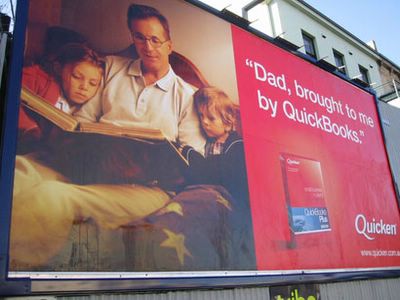
From the distance of the other side of the road it looks just like a regular advertisement on a billboard. You can’t really tell what it’s an ad for until you get stuck in traffic or pass closer to the billboard on its dangerous Anzac Parade location.


Up close it soon becomes apparent that John McDonald, esteemed art critic for the Sydney Morning Herald, is now moonlighting in ads for Quicken [seen here with his daughter Ruskin and son Peter Jr.] We were a little perplexed why McDonald would be doing in an ad for an accounting product until we gave the Australian distributor a call. The product in question turns out to be an automated art critique program that the esteemed scribe can leave running to produce his weekly pages for Spectrum while he catches up with the kids. Seen here reading aloud from a bound edition of Modern Painters: Reflections on British Art, Quicken is quietly steaming away in the background: F1 [Sarcasm], F2 [Appeal to common sense], F3 [Attack the MCA], F4 [Deplore lack of skill in contemporary art], F5 [William Robinson is a genius], F6 [Attack Mike Parr] etc etc etc.

Labels: ,

Getting Out The Big Guns

Wednesday, March 10, 2004
The Art Gallery of NSW has a screening of Matthew Barney’s Cremaster Cycle – something of a first – and how do the ‘quality’ broadsheets react? They get out their big guns.

Over at the Sydney Morning Herald, the editors were no doubt scratching their heads and wondering who they could possibly get to cover this important event. Obviously the name of their most respected arts writer sprang to mind, a person with weight, authority and experience; the sort of writer who could give credibility to both the article and the newspaper as a whole, someone who would know how to string a series of a mindless descriptions together into one long sentence until it’s like washing day at Adjective University. Who should they get to preview the Barney Screening? Why, it’s the return of Lenny Ann Low! And where should they put this masterful work of journalism? Let’s put it in 48 Hours, the section of the Herald reserved for trivial bullshit…

“Judging by the cycles varied content, Barney’s artistic interests also lie in pristine, athletic women, death metal music, murderers, bees, fashion, fantasy, Mormonism, the Freemasons, twisted dentistry, violence, slapstick comedy, car culture and the ability to gross people out.”


We can’t be bothered to go on with Low’s piece, let’s just say that it continues her high standards of rewriting press releases with a good dose of her own school-girlish excitement mixed in. So Barney is interested in “violence” and “the ability to gross people out.”? She could be just as well talking about American Pie...

At The Australian, there were no deliberations. They had Sebastian Smee’s phone number.

American writer Janet Malcom once said that the spell of any work of art can be shattered by the sound of a nasty little voice in one’s head ‘But this is ridiculous.’ In front of the work of Matthew Barney, there’s no doubt this little voice can be unusually persistent…


So began Smee’s preview of the Barney screening. You’d be forgiven for thinking that by this opening Smee would go on to explain why this ‘nasty little voice’ should be so persistent in front of the work of Barney. But no, it’s really just a cynical opener for what is otherwise an uncritical interview with the artist.

Smee does talk about people in the art world talking about Barney; that the consensus is that he is “on par with the most famous living artists.”

The films have been screened at selected venues on special occasions (Cremaster 2 was shown at the Sydney Biennale in 2000, but during the screening I went to it had to contend with a persistent heckler). But even in the art world, most people who whisper about Barney’s genius have not yet seen his work.

Compounding the oddness has been Barney’s insistence that the five films are only one strand of a project that he sees as essentially sculptural, and that al the different elements of his work ideally need to be seen as one. The critical consensus, however, has been that the drawings, photographs and sculptures (made from Vaseline and other materials) are simply not as interesting as the films and that the exhibition of all the elements combined diluted the impact of the latter.


While Smee – a writer who trained at the Sydney Morning Herald and was a protégé of John McDonald – is much admired by fellow journalists for the clarity of his prose, his conservative opinions shine through. In fact, his use of classic right wing “straw men” as a driving rhetorical device puts him more in the tradition of the dreaded Giles Auty than McDonald.

Why is this nasty voice so persistent? Who are the people who are “whispering”? What "critical consensus" that says the other work “simply isn’t as interesting”? Who is saying this? How about a reference or two?

Don't expect answers to these questions - it's a standard ploy of writers like Smee who lead with their opinion and unverified "facts" and then place them in the way of the reader. As you bump into them, you get the sense that the writer doesn't really like what they're covering but are too chickenshit to either say so or find a decent source who will do the dirty work for them. Barney is too hard and too contemporary and too hermetic for a lightweight like Smee to really say anything at all. What you get in place of a properly reasoned argument is snivelling cyncism that's symptomatic of the Young Fogey approach to art writing.

The suspicion is that Smee doesn't really know what he's talking about. He refers to a screening of Cremaster 2 that was spoiled by a persistent 'heckler'. You'd think by that inclusion in his article that there are people out there who really agree with Smee's unfounded assertions, that some unnamed "consensus" secretly believes that Barney's work is just "ridiculous"...

The Art Life was at that screening and stayed all the way to the end. When the lights came up it became apparent to everyone at the cinema that the "heckler" was in fact a mentally disabled adult in the company of his mother.

Where was Sebastian Smee?

Labels: , , ,

What The Critics Say #2: Kicking Arse and Taking Names

Wednesday, February 25, 2004
Writers have to stake their claim in the first few sentences of an article – the classic ‘lead’ in a story is the hook that keeps you reading all the way to the end. Art writers working for newspapers and magazines have to get to the point pretty quickly or they will lose their readers. Some writers have absorbed “art speak” and mix it liberally with newspaper style prose, while others are labouring without regard to good writing at all.

Writing the Galleries column in the Sydney Morning Herald, Anne Loxley appears to have learned a thing or two about a snappy lead:

As with any market offering products in today’s competitive and sophisticated environment, art dealers and gallery owners work hard on their image and market position.

At one end of the spectrum are those promoting themselves as offering sure-fire investments. Indeed, some dealers go so far as to describe the works they sell as “blue chip”. While no such claims are made in writing for A Selection of Contemporary Australian Art at Martin Browne’s Macleay Street gallery, the implication is there…


Art dealers work hard on their image. Some offer what they call “blue chip investments”. No such claims are made at Martin Browne Fine Art. But the implication is there?

The key phrase in the above paragraph is no such claims are made in writing. Let’s restate that: Martin Browne Fine Art does not make a claim in writing that what they are selling are blue chip investments. In fact, the only claim they make in writing is that the title of the show is A Selection of Contemporary Australian Art.

You are probably wondering what Loxley means when she says “the implication is there”. What she means is that Martin Browne has successfully marketed his artists to a select clientele of lawyers, property investors and the like, sold these paintings without much in the way of excessive advertising (just the usual art world ads in magazines and the odd line-ad in a newspaper), created a stable of artists mostly made up of refugees from other galleries, and has recently expanded into a brand spanking new gallery space across the road.

So what’s the beef here? Perhaps Loxley has a problem with the fact that Browne has made a lot of money from his artists and shares in the profit from future sales. While this kind of approach to the business of running a gallery is quite different to many galleries – where even the highest profile artists receive exactly nothing from their dealers between exhibitions and the odd sale – it’s hardly a claim for blue chip status. One can argue the merits of individual artists and why they can command certain prices, it’s presumptuous to make a claim where none actually exists.

Whatever the reason for Loxley’s problem with Martin Browne, she certainly doesn’t like the artists who show there:

She says of an Emily Kame Kngwarreye painting included in the show that it “is far from the artists best work.” Loxely would be surprised if William Robinson didn’t “agree that his series of ceramics of swimmers, such as Lifesavers and Bodybuilder (1997) is an unremarkable area of his oeuvre.” Poor Bill Robinson – one minute a maker of masterpieces, the next just unremarkable.

Loxley cannot understand the popularity of Tim Maguire – perhaps its got something to do with the decorative nature of the work? – and has little time for McLean Edwards ("illustrative, discordant"), Chris Langlois ("vacuous") or Neil Frazer ("clumsy").

Blimey – an art critic from the Herald with an opinion that she’s not afraid to spray around! But wait, there’s more:

I cannot forgive Roy Jackson his obvious debt to Ian Fairweather and Savanhdary Vongpoothorn’s neat pierced paintings do not deliver any of the promise of her earlier work. In an exhibition of nice painterly finishes, Ildiko Kovacs and Aida Tomescu stand out for their rigour – but even these artists must be wary of repetition.


So there you have it – even for the good artists in the show, there are dangers ahead. And where does Loxley take the blue chip lead? Precisely nowhere. In the next paragraph she discusses a Mardi Gras related exhibition at the Cross Art Projects space and imagines that “here is a gallery where blue-chip are probably dirty words”.

We can’t imagine why an exhibition of work by struggling artists would hate to be considered a sound investment – if they were they wouldn’t be struggling, would they?

Loxley’s ‘blue chip’ lead is tenuous to say the least, and in some cases downright misleading. Loxley should have just fessed up that the thing that really irks her is Martin Browne’s mixture of gallery artists with secondary market pieces masquerading as a “show”.

On Fridays, the SMH’s Metro liftout carries two pages dedicated to exhibitions. Until last year, the pages were written by Victoria Hynes (who has since left to fill the deputy editor position at Australian Art Review under fellow Herald journo and new editor-in-chief Ruth Hessey) or Lenny Ann Low. Hynes was a dry writer – facts with a bit of scholarly flavouring. Low, on the other hand, specialised in clichés that collapsed on the reader like an avalanche rolling over a hapless alpine skier. After her thesaurus was exhausted, Low was moved on to mini-features leaving the Exhibitions pages open to Dominique Angeloro.

Angeloro is a competent writer, specialising in just-the-facts reporting, that sometimes reads like a rewritten press release:

The Mass Psychology of Fascism, Zip-a-dee-doo-dah, Zip-a-dee-ay is a collaboration between Mike Parr and Adam Ceczy that interrogates the ease with which the media translates images of human injustice into empty spectacle. This video installation powerfully critiques these aesthetics, renegotiating the viewer’s reception of Parr’s horrific Artspace performance where he stitched his face together last year. The unrelenting viewing experience is marked by the nauseating swinging motion of the camera work and the incongruous, happy go lucky soundtrack of the work’s title.


At least it tells you what the show is about, but perhaps go a little easier on the art speak?

Still, it could be worse, a lot worse.

There is nothing quite like the art writing that accompanies new media. Forced to invent new words and grammar to encompass the sheer newness of new media, writers and artists are often one and the same person, since very few are interested in it, and to get the coverage, you need to go out and do it yourself. We have no problem with new media as such, nor digital media, screen media or whatever you want to call it, but we do have a problem with Darren Tofts (an artist and writer) writing about Ian Haig (an artist and writer) in Real Time (+On Screen) in an article called Machineries of joy: Futurotic:

Futurotic manifests Ian Haig’s ongoing interest in the strange relations between the body and technology and, in particular, the peculiar and often disturbing uses people find for gadgets that increasingly surround us at home and work. While the impetus for Futurotic arose from this interest in “looking at everyday technological items and re-thinking them, transforming them,” the specific preoccupation of this work involved the perverse sexual uses of domestic appliances. In the context of the trajectory of Haig’s work, there is something appropriate in this conjunction of, for example, vacuum cleaners and masturbation. But there is actually a vast literature devoted to the history of domestic appliances as sex devices and Haig has clearly done his homework.


Sadly, this “vast literature” goes without citation.

Labels: , ,

“Excuse Me, But Can I Have $2 Please To Get The Bus Home, Please?”

Tuesday, February 17, 2004
We were going to give Peter Hill a rest for awhile but he’s gone ahead and surprised us. Normally mild mannered and unbothered by a critical position, Hill has made a statement or two in his latest Spectrum piece. This may be the first time, we’re not sure, and we’re equally unsure if he’s joking. We can only hope so.

One of the perks of being a journalist is that if you go on holidays and you can find a story to write while you’re away, the whole trip is tax deductible. Sweet. Thus, it wasn't unusual to open The Sydney Morning Herald and discover that Bruce James was in Paris or London or somewhere writing a ‘review’ about a collection of Old Masters at the Tate or Goya at the Prado or something.

These days, however, Hill has a much more modest travel itinerary, filing pieces from Perth or Canberra or New Zealand. And so Hill has given us a review of exhibitions in Waterloo, Sydney and Auckland and Dunedin in New Zealand. Like James and his stories of past international travels, it’s difficult to work out what the relevance of publishing a story like this really is. The Art Life hears that the Dunedin Public Art Gallery is a happening place, but the likelihood of us ever going there is remote, and unless Hill has some grand point to make about the relevance of the art there, it’s a bit of a waste of time.

Luckily, Hill does have a point to make and this is where we were startled by the sudden appearance of a critical position. Reviewing a show called Pressing The Flesh: Skin, Touch, Intimacy at the Auckland City Gallery, Hill addresses the show’s themes of despair, bleakness, repulsion and black humour as seen through individual artist’s work:

There is seduction and seduction in [Pat] Brassington’s tongue-like contortions of flesh. […] There was honesty, imbalance, and poignancy in [Mike] Parr’s photograph of himself with a missing arm and his wife, Felizitas, with a mastectomy.

But it was in Polish artist Artur Zmijewski’s work that we found the bleakness – the madness – and yes, perhaps the black humour that verges on conceptual lunacy. On a domestic-sized television screen we see nudists playing tag in a former concentration camp gas chamber. Not beautiful young nudes either, but fat, middle-aged nudists. When confronted with this work, I didn’t know whether I wanted to be part of an art world that produces such things, or whether it would be worse to be in a world that didn’t.


We know how you feel, Peter.

Rereading the review, it could be that Hill was joking when he wrote these two paragraphs – confronted equally by the fact that the TV was “domestic sized” (whatever the hell that is supposed to mean) and the images of fat nudists desecrating the memory of the Holocaust (or were they???) – he just doesn’t know what to make of it. Confusion is an honest and reasonable reaction to a Eurowanker artist, and we applaud Hill for admitting it

Unfortunately, instead of complimenting the curator Robert Leonard for including a work that actually stopped him in his tracks, Hill chastises him for including the work of Santiago Sierra.

Sierra represented Spain at last year’s Venice Biennale. His work in Auckland raises even more ethical issues. ‘[Sierra] employed four junkie prostitutes to have lines permanently and pointlessly tattooed across their backs, paying each with a moment’s bliss, a shot of heroin,’ Leonard writes. ‘This cruel work exposes inequities, but perhaps comes close to being exploitative itself.’ I don’t think there’s any ‘perhaps’ about it. It is exploitative, and the curator who shows it is in league.


In league with the Devil, no doubt! For crying out loud, who put Peter Hill in charge of the morality police? We only have the artist’s word that the participants are “junky prostitutes” and even if they were, so what? Aren’t the “junky prostitutes” (and we mean that in the nicest possible way) capable of making a decision for themselves? Give ‘em cigarettes and bus fair home next time. So this is Hill's critical position - finger wagging, zero tolernace, PC-do goodness that wouldn't bother John Howard.

Speaking of Satan, Hill concludes his article with a small aside on an exhibition of Pre-Raphaelite painting in Dunedin.

It’s the sort of thing Andrew Lloyd Webber buys – in fact he wrote recently ‘I write music in order to buy paintings.’ Good on him. There should be more like him.


Well, that’s Lord Lloyd Webber to you, he buys Victoriana, and writes cheques for the Conservative Party, who were the ones who made him a “sir”. Do we need more like him? More Miss Saigon, Chess or Cats?Bah.

Labels: , ,

What The Critics Say #1: A Whole Lot of Nothing

Thursday, February 12, 2004
Peter Hill is a reasonable enough artist. An expatriate Scotsman who makes easy-to-digest conceptual art, he’s best known for The Museum of Contemporary Ideas and exhibitions in far away places like Tasmania and Melbourne. He’s not, however, known as a writer, critic or essayist - which made his appointment as the art critic for the Sydney Morning Herald’s Saturday Spectrum section something of a mystery.

After the horrible, depressing years of John McDonald, Sebastian Smee and the all-too brief years of Bruce James, it seemed as though the SMH had completely given up on visual arts. With the newspaper concentrating on subjects that would draw badly needed advertising dollars to Fairfax such as books, movies and music, visual arts at the Herald were hived off to adjective-happy journos, jobbing freelancers and photo ops for page 3.

They had book reviewers, they had film critics, they had dance, theatre and rock writers, but they hadn’t had a proper art critic in over a year. Let’s just put aside the fact that the art market is stronger now than it has ever been, that interest in the arts by the newspaper’s core demographic is at an all time high and that these are the very same people who are buying art – let’s just assume that the SMH had its reasons for not covering art.

So when Hill made his first appearance in Spectrum it seemed as though, at last, the newspaper was getting serious. It soon became apparent that Hill wasn’t that keen on voicing an opinion. It was true, he did like a lot of more cutting edge work than his conservative predecessors, but he was averse to telling you if it was any good or not. With the residual angst of the McDonald/Smee decade still hanging like a disgusting fug in the air, it was wiser to just let Hill have his time and get to grips with the demands of a weekly gig on a newspaper. He’d come good eventually – that was the hope.

Sadly, it hasn’t worked out that way. The best thing you can say bout Hill is that he's never seen an exhibition he doesn't like, he's always positive, always accomodating - buthe's also the most mediocre writer imaginable. His boss at the SMH, Michael Visontay, refers to Hill as a “reviewer” and not a “critic”, perhaps giving an indication of the section’s light-n-easy editorial policy. But by “review”, it’s fair to assume that that means some sort of critical evaluation. But Hill’s writing is almost completely beige – it has nothing to say and leaves the reader with the sensation of having just swallowed air.

In a recent “review” of four shows, Hill used this lead for his article:

“It’s a brave person who attempts to predict the future, although trends in art are probably slightly easier to predict than trends in literature, partly because most exhibitions – from commercial to museum blockbusters – are planned in advance. The great contemporary example of this was Magiciens La Terre at the Pompidou Centre in Paris in 1989, which had a gestation period of a decade, yet still took many people by surprise.”


Perhaps by “the future” Hill just meant what's coming up at your local gallery – not an actual Nostrodamus-style prognostication on the future. Still, it’s a catchy line even if it’s criminally wasted by the qualification that follows. Hill seems ignorant of the fact that books too are scheduled for publication many years in advance, often a decade for big series like Thames and Hudson and Phaidon’s recent publications – so we’ll leave that alone. What is more perplexing is how Magiciens La Terre took people by surprise – he doesn’t explain, and never returns to it in the rest of the article. But what the hell, right? It's just the lead to the article. There's much more exciting stuff to come...

Three more paragraphs followed that explained in tedious detail something Hill had already said at the end of his second sentence, namely, that exhibitions are planned in advance. For example:

“What you will be enjoying at New York’s Guggenheim in 2007, or at the Art Gallery of NSW in 2006, or at the Moderna Museet in Stockholm is largely known. Catalogue writers have already been commissioned. Loans and exchanges are, even as I write, being negotiated and swapped like blue chips in a casino."


Dig that casino analogy!

In all fairness, perhaps Hill has been briefed to address his column to a readership that knows absolutely nothing about art and think that gallery shows are pulled out of big freight boxes that get delivered by some trucks from somewhere. That doesn’t seem so likely, as the lit reviewers elsewhere in Spectrum can be as obscure as they like. On the one hand Hill assumes we know what the hell he’s talking about when he mentions Magiciens La Terre at the Pompidou but, on the other, not that exhibitions are planned events. Who are we, the readers of Peter Hill? Confused, probably.

Hills populist credentials are on display when he neatly segues from this exciting introduction when he big-ups Liverpool Street Gallery for having a group show of gallery artists called (suprise surprise), Group Show – something that all galleries do at the beginning and end of every year when artists, gallerists and audiences are too addled from the holidays to mount enough concentration for a proper show. We can be thankful for one thing, however, as Hill points out that Liverpool Street Gallery is “light filled” – something you would think would be a priority in an art gallery.

No detail is too small for Hill, quoting liberally from the catalogue to the show – he lists all the artist’s names, the prices their work sell for (“$3,300 to $125,000”) and includes a few un-attributed quotes that are presumably taken from artist’s statements supplied by the gallery

One artist, John Beard, has his work illustrated in the review and it looks like a head. In fact it’s called Head Self Portrait No. 10 (2000). Surrounded by some expressionistic daubs, it’s all very artistic and you can tell the artist is a real painter. Confronted with the work of art itself and freed of tedious things like setting up the story and filling up space with the names of artists in the show, Hill can let rip and tell us what he really thinks.

“[Beard’s] work has reached a greater balance between portraiture and landscape than any other artists I know…”


Well, there you go! It’s half a portrait and half a landscape and, what’s more, in Hill’s experience, it’s the best balance possible. Is that a 50-50 balance, or 70-30 – or what? Are those expressionist daubs a landscape? Hill doesn’t explain these cryptic remarks. It'd be interesting to hear his thoughts on something that really blows his socks off.

Later, discussing the work of Kate Tunerin the same show, Hill gives us some badly needed detail on her career, information that you’ll no doubt be quoting at dinner parties, while spicing things up with another scintillating insight into the world of contemporary painting:

“Turner, a masters graduate from the University of NSW’s College of Fine Arts, has been an artist in residence at Arthur Boyd’s Bundanon studio. Her paintings project a fragility and an overall resonance that I can only compare to a perfectly hit note on a tuning fork. You need time to fully appreciate these paintings and, as you stand there, gradually a tree or a shadow will emerge from what at first seems like an abstract colour field composition.”


While it’s surprising that Hill didn’t spell out New South Wales to waste more space and meet his word count quota, the sheer anodyne boredom that this kind of writing provokes is breath taking. Here we have an art critic whose only job is to describe a work of art and tell his readers if it’s any good or not resorting to a needlessly obscure and none too descriptive analogy involving a “perfectly struck tuning fork”. That ringing in your ears is the pain you’re experiencing from Hill’s writing, not from some out-of-body experience invoked by the beauty of Turner’s painting, which, by the way, is abstract with some figurative elements.

The rest of Hill’s column pulled the same tricks again and again, with some headache inducing statements of the bleeding obvious by Bill Nuttall , an advert for Artlink magazine - that august publication people turn to when they want to know what’s happening in post-Colonialism or “the body” - and a mention of a caligraphy show and an exhibition at Roslyn Oxkley 9 Gallery.

"We tend to think of calligraphy as an art form of the past. Go along to this show and be disabused..."


No kidding, eh? We're always looking to be disabused, and if it's about calligraphy, all the better.

John McDonald was a destructive, mean and conservative voice in art criticism. His protégé Sebastian Smee was simply an idiot with nothing to say – as his subsequent career as an international journalist for Oxygen , writing shallow and ridiculous articles on Picasso and Matisse ,has proven. Bruce James, a friendly fellow and supportive voice for contemporary art, ultimately turned out to be fickle, giving up on the politics at Fairfax for an anonymous career within the ABC.

It's hard to remember life before the current crop of nobodies - people like Elwyn Lynn, Terence Maloon and, way back in the 70s, Nancy Borlaise -people who had an opinion, could express it, and made a contribution to the art world. It just didn’t seem possible that it could get worse at the SMH – and then along came Peter Hill. As the boys in Spinal Tap put is so eloquently, Peter Hill is filling a badly needed void.

Labels: ,