<body><script type="text/javascript"> function setAttributeOnload(object, attribute, val) { if(window.addEventListener) { window.addEventListener('load', function(){ object[attribute] = val; }, false); } else { window.attachEvent('onload', function(){ object[attribute] = val; }); } } </script> <div id="navbar-iframe-container"></div> <script type="text/javascript" src="https://apis.google.com/js/platform.js"></script> <script type="text/javascript"> gapi.load("gapi.iframes:gapi.iframes.style.bubble", function() { if (gapi.iframes && gapi.iframes.getContext) { gapi.iframes.getContext().openChild({ url: 'https://www.blogger.com/navbar/6466083?origin\x3dhttp://artlife.blogspot.com', where: document.getElementById("navbar-iframe-container"), id: "navbar-iframe" }); } }); </script>

the art life

"...it's just like saying 'the good life'".

25 Predictions for The Future

Monday, October 30, 2006
1. In the future there will be no art because everything will already be art.

2. In the not too distant future a wall will be built that will seal off the Eastern Suburbs of Sydney from the rest of the city. Only people with government issued day passes will be allowed into the Eastern Zone to see shows in commercial art galleries. Once their business is completed, people will have to leave immediately or face deportation and a permanent ban on entering the Eastern Zone again. The strangest feature of this wall is that it will be psychological only and have no actual physical manifestation.


3. In the future, musicals will be staged in Sydney celebrating 9/11 with an all-singing, all-dancing, all-Australian cast.

4. In the far future someone will adequately explain the relevance on non objective art.

5. By the end of the year we will be suffering through the Great Anecdote Crisis of 2006. It will be a terrible time. People will run out of stories and everyone will be reduced to talking about the weather. The Sydney art scene will begin to grind to a halt by late November. To alleviate this terrible situation, the Federal Government will import anecdotes from New York and London and Tokyo until people can again begin to confidently tell their own stories. The Crisis will finally pass by February 2007 when everyone gets back from their holidays.

6. In the future, painting will make a big comeback.

7. It might seem that in the future things will be different. The surprise is that things tend to stay very much the same, there’s just a lot more of it. Way back in the 1970s not long after we first became conscious of ‘culture’ the way to find out about things was to watch TV, go to the movies or, if you had a marginal, specialist interest, you bought specialist, marginal magazines. The lines of communication were slow and it took a long time to find out about anything. By the time we saw the Sex Pistols on Countdown they’d already broken up. Places that seemed impossibly exotic – South America, Japan, Eastern Europe – were lost inside information blackouts. In the mid 1980s very little had changed but by 1993 the future we live in now was on the horizon. Instead of finding about a band before they’ve broken up, we’re actually buying tracks on iTunes even before a band have even formally released anything. The main difference between now and the past is that communication, mobility and availability has increased exponentially. The future we can see coming is one of immediate availability wherever we happen to plug in, and it will affect the off line world just as profoundly as the on line one.


8. Future historians will look back on this period and wonder why, in the face of some of the most important events and issues to face us, artists largely chose not to use these events and issues of the day as the subject of their work. After much study, some historians will come to the conclusion that art in the early 21st century had collapsed into a solipsistic self regard from which it could not awake. Other historians will argue it is the nature of art to only reflect the interests of artists which, to a large degree, is only ever about themselves. The first group of historians will argue that this precisely what they mean by “solipsistic self regard” prompting the second group of historians to demand that the first group put up or shut up, in turn prompting the first group to issue a challenge for an all-academic dance off to decide, once and for all, who is the “illest” and most “fly”.

9. One day the day will come when the day will not come.

10. In the future, painting will become obsolete and drawing will become the new video.

11. By the end of the next decade, there will be so many travel grants, scholarships, overseas studios and residencies available, artists will only have to punch in a their personal ID code at a handy info kiosk at the airport before they can jump on the next available trans-orbital shuttle to an exotic destination where they can while away their time making art while being appreciated by far more open and accepting societies than our own.

12. By the end of the decade, all DVDs currently being produced and sold by artists will be obsolete, unable to be played on any domestic machine and all the current work will be consigned to libraries, museums and other such institutions with specialist playback facilities.

13. Eventually the ability do something will be admired, but the ability to do something but choosing not to do it will be admired even more. The following shift in fashion, the ineffable excitement of doing, will carry us on towards a backlash towards not doing, and so and so on and so on…

14. In the future, artists will come to realise that everything is connected. Commercial galleries can only exist because of their artists who graduated from art schools attached to fully funded universities; and who worked in, showed at and helped continue operating artist run galleries; but these artist run galleries will have only continued to exist because the people who run them realised that, to ensure continuing funding, they had to vote for the political party with a policy that would allow the profits of the sale of work by dead artists through auction houses to be taxed to allow the payment of fees for living artists in public museums and galleries; and that the profits of sales of works by living artists should go to them regardless of how many or how few actual works of theirs are sold at auction because, after all, they were the only artists in the community who did not share in a royalty scheme for the repeat sale of their work and; although they may be indigenous, they had as much right to decide who got to spend their money [i.e. them] than some suit in an auction house.


15. By 2050, all of this will be underwater.

16. Sculpture will be considered the new video when video becomes the new painting leaving a space for sculpture to become ever more popular. In the future, however, space will be at premium as the population of Sydney exceeds 25 million and there will be very little room for things on the floor. Thus, sculpture will relocate to walls and will be very flat with few sticky out bits, in turn signaling the final victorious return of painting from the DVD player to its natural home, the wall.

17. In the year 2525, if mankind is still alive, a bottle of Firstdraft West Shiraz will fetch close to a million dollars at auction. The wine however will not be drunk, but the bottle placed inside a special sealed transparent tube where it will be viewed by all those wishing to observe “alcohol” next to some “nicotine”.

18. In the future artists will only make art, writers will only write, curators will only curate and the audience will appreciate their efforts.

19. A point of special interest to future historians will be why, during this current period of the proliferation of new technologies, new distribution modes and delivery mechanisms, even the most so called “cutting edge” art was in fact mostly based in technology at least a decade old, or if seemingly more up to date, why was its content repeating well worn generic positions vis-à-vis the situation of the artist, the audience and the delivery device? People will look back at the death of commercial galleries with a sense of wonderment that such antiquated 19th century sales techniques were being deployed well into the 21st century. It will be asked why artists seemed to want to continue a system that actually disadvantaged them in a profoundly unequal economic relationship.

20. In the future, the following reasons for not liking an art work will be automatically disqualified and, in extreme cases where these reasons are combined into what is called a “prejudicial view”, the person may be sentenced to 25 years in prison and/or a $25,000 fine:

a] The work of art does not meet my expectations of what I think the artist should be doing;
b] The work of art reminds me of something I saw overseas;
c] The work of art vaguely reminds me of something I saw 20 years ago;
d] The artist is doing something I want to be doing and am not actually doing it, or,
e] The artist is doing something I am doing but getting a lot more publicity for it than I am or;
f] I have no interest in the form the artist chooses to use to make their art and therefore it is rendered ineligible for my consideration.


21. Eventually the semi-sentient group life form known as The Art Life will cease to exist.

22. Very soon we will no longer be able to travel overseas because of skyrocketing fuel prices, ozone depletion and a security crackdown on all unnecessary air travel. Aside from the super rich who will be able to afford it, or those with enough time to work their passage to Europe onboard a container ship, art culture will only be about the country and probably just the city you live in. The upside will be a concentration of artists in one place who have only each other to entertain.

23. To celebrate its centenary in 2086, October 28 will be promulgated as Firstdraft Day, a national holiday for all artist run spaces. Its influence and effect on the Sydney, national and international art scene will be acknowledged by all, and its many organisational quirks will be similarly acknowledged as the reasons for its continued existence.

24. Someday quite soon art will be understood mainly as a practice and philosophy of communication. An audience consists of people who generally want to understand what an artist is doing. If an artist has something to say, by and large, the audience is at least curious to know what it is. If an artist fails to communicate or, more dangerously, celebrates the fact that they haven’t, or will not communicate, an audience has every right to hunt down the artist to exact their revenge.


25. A saying of the future will be “the proliferation of forms alone does not guarantee variance” meaning that just because there’s a lot of something doesn’t necessarily mean it’s a good thing. The so-called crisis in art criticism is about the proliferation of a certain kind of art writing, and the sudden drop in numbers or the actual disappearance of other kinds. Although we fear the death of one thing and hang on to memories of what we thought it once was, or could be again, we need to take advantage of situations as they occur, seeing in these developments opportunities to exploit creativity in new venues. It may be in the near future that the continuing stand alone gallery funded by government largesse will disappear. The challenge is either to forget the old model and to find new opportunities, or the challenge is mount an effective fight back. Either way, the only way to make things happen is to make things happen.

Labels: ,

Duck and Wine Soiree

Tuesday, October 24, 2006
The Art Life is taking a short break. We will return next week with a brand new podcast and a full update of the blog to follow. In the meantime...


twentylove
20 years of firstdraft gallery


Firstdraft is pleased to present the twentylove forum series, a free series of discussions at the gallery open to all on Saturday afternoons throughout October. Our final forum is this Saturday from 2pm – 4pm October 28 2006:


Onwards – avenues within the contemporary arts


There is a wealth of possibility in the contemporary arts. Emerging artists, curators and/or arts workers need to be ingenious in making their own way, without clear trajectories to success, fame or fortune in this dynamic sector. From a variety of perspectives these eminent identities will scope our contemporary arts community. Join the discussion on opportunities, challenges and aspirations - what’s going on at the moment and what next?

Speakers:

Reuben Keehan is Curator at Artspace Visual Arts Centre, Sydney, and a frequent contributor of critical writing to numerous publications and exhibition platforms, maintaining an art practice somewhere in between.

Sophie O'Brien is currently Coordinating Curator & Exhibitions Manager for the Australia at the Venice Biennale 2007. Sophie previously worked on Venice Biennale 2005 and the Biennale of Sydney 2004, and was Curator of the Visual Arts Program at the Perth Festival from 2000-2002. She has participated in the Curatorial Program at De Appel, Amsterdam and was an Assistant Curator at the Art Gallery of WA. Sophie has curated exhibitions including Plan B, do it and Stan Douglas / Bill Viola and Multiplicity, and also writes on contemporary art for local journals. Earlier this year she undertook a residency in Tokyo to research contemporary Japanese art and alternative exhibition models.

Aaron Seeto is an artist/curator based in Sydney. In 2006 he received a grant from the Australia Council for the Arts to attend the International Studio and Curatorial Program in New York City. He has exhibited both in New York and throughout Australia at the Gigantic Artspace (2006, New York City); Gallery Korea (2006, New York City); Centre for Contemporary Photography (Melbourne); Art Gallery of New South Wales (2004, Sydney); Artspace (2005, Sydney); Robert MacDougall Art Gallery (2005, as part of the Scape Biennial, Christchurch); Gallery 4A (2001); Casula Powerhouse Art Centre (2001). His work is in the collection of the AGNSW, the University of Wollongong and private collections. He was recently the Curator at the Asia-Australia Arts Centre and has also curated exhibitions for the Museum of Contemporary Art (Sydney), Asia-Australia Arts Centre (Sydney) and has curated projects for the Asia-Australia Arts Centre, Canberra Contemporary Art Centre, New England Regional Art Museum.

Soda_Jerk (Dan and Dominique Angeloro) are two Sydney-based remix artists working across the areas of video, photo-collage and installation. They work exclusively with found material, re-combining fragments of film footage, audio tracks and vintage image culture. Soda_Jerk also work collaboratively as independent curators and arts writers.

The Art Life is a blog published four to six times a month that covers the Sydney art scene in all its glory. Since its launch in 2004, The Art Life has grown exponentially attracting many thousands of readers a week. In early October the blog started podcasting its bi-weekly appearances on Eastside Radio and quickly became one of the hotest art podcasts on the web, rated No. 15 on iTunes top 20 art podcasts and is downloaded by listeners from all over the world.

Anthony Whelan completed an Honours degree in Fine Art (Photomedia) at the College of Fine Arts, UNSW. He was a founding Co-Director of Rubyayre Gallery (later to become Wren Gallery). He is currently Assistant to the Director at Sherman Galleries and curator of Sherman Artbox, a 'mini-exhibition' space dedicated to the promotion of artwork by emerging artists. Anthony also maintains an independent curatorial and artistic practice.

Take part in the commentary on Firstdraft’s longevity, and discuss possibilities and priorities, aspirations and challenges for artists and ARIs in Sydney and further afield.


Refreshments will be served.


Firstdraft
116-118 Chalmers St, Surry Hills NSW 2010
t: +61 (0)2 9698 3665 e: mail@firstdraftgallery.com
http://www.firstdraftgallery.com/
Firstdraft opening hours: Wednesday-Saturday 12-6pm
(During twentylove - Tuesday - Sunday 12-6pm)

Labels:

There's Still Time

...to win a FREE copy of McCulloch's New Encyclopedia of Australian Art courtesy of The Art Life and Aus Art Editions. The door-stop sized reference work has over 1,000 pages, it's fully illustrated and finally answers the age old question; Is Ken Done worthy of inclusion?

All you have to do to WIN is send us a bio up to 100 words on the great, late Pro Hart. Your entry need not be an actual bio - it could be a limerick, haiku, perhaps a drawing of the great man. It's up to you. We have ONE COPY to give away FREE and THREE at $50 off. Entries for this fine competition close October 31, so get 'em in to: theartlife[at]hotmail.com.

Labels:

Word To Yr Mutha

Hi there, My names matt allen, My house mates and i have decided to open up our house one night a month to the sydney art world. We will be holding free one night events for local emerging artists/muscians/writers.

On the 27th of Oct we are showing a body of drawings by the artist Teo Treloar, i was hoping you could chuck up a lil pic and blurb about our space to spread the good word? Please drop by and have a beer with us. Thanks!


- onefourteen presents -

Teo Treloar "fragments-drawings"

114 Surrey St (off Victoria street) Darlinghurst 2010

Friday 27th of Oct, 6pm


*


*


2SER Stripathon


Yes, I know it's tacky as hell - but whover said I was classy?

I'm afraid it's a very odd world when GENDER STUDIES academics start stripping in public as a way of soliciting cash from the general public - but these my friends are hard times.

this monday 23rd October from 2-4pm
WILL BE THE WORLDS FIRST EVER RADIO STRIPATHON


It's on the radio, so use your imagination...


Daz Chandler and Mayhem will be together for 2 whole hours - blabbing about art, life and pink bits and taking their clothes off for cash.

Basically we'll remove one item of clothing for each listener who rings and subscribes to 2SER during the course of the show.

You can go to 107.3FM if you've got one of those old fashioned analogue thingies - or you can stream from here And just ring: 9514 9514.

WHY SUBSCRIBE?

the legend that is the artandmayhem blog came out of the tiny little segment on 2SER - so supporting 2SER - means supporting an independent, well informed voice on art. (mine & lucazoids) and god knows we need some of that. in additional - 2SER - plays shitloads of great music, has heaps of fantastic programs, independant journalism and subscribers get lots of free stuff.

WITH THE CROSS MEDIA OWNERSHIP LAW CHANGES AND RUPERT BUYING EVERYTHING GOD KNOWS WE NEED ALL THE INDEPENDANT MEDIA WE CAN GET!!!

Most poeple at 2SEr are volunteers. And the unis that initially funded the station and training - no longer can afford to - so the station needs the support of subscribers even more than before. Subscription to 2ser is as cheap as chips for the benefits and good karma that will be heading your way. Check out the prices below:

Type of Subscription/Price per year
Individual Concession $33
Individual Standard $55
Individual Passionate (just cause you love us!) $110
Business $220
Community Group or Not for Profit Organisation $110
Artist (Band, DJ, indep artist or coop) $110
Lifetime Membership $550


Plus you'll get the postmodern kudos of encouraging feminists to objectify their bodies. And each clothing removal will come with an erotic audio description -
so you get free audio porn into the bargain.

what could be better?

*


*


TCB

FRONTSPACE

still lives
colleen ahern & mateja simenko

BACKSPACE

eveline tarunadjaja

RUNWAY Magazine launch

November 1 6-8pm

exhibition october 25 - november 11

TCB artinc. artist run space
level1/12 waratah place
melbourne VIC 3000
+613 96638233
tcbartinc[at]optusnet.com.au


*


*


VENERDI 27 OTTOBRE ORE 20
AUDITORIUM "SALA STUDIO"
Viale De Coubertin 30


il Festival Internazionale della Poesia organizzato in collaborazione dell'Electronic Art Cafè presenta:


"IL RIBELLE IMMINENTE"
atto unico di Achille Bonito Oliva


musiche di Antonio Caggiano, poesia visiva di Nanni Balestrini
oggetto scenico di Luigi Ontani, performance di Matteo Basile e Robert Grigorov.
Ritratto fotograficoRocco Dubini.
Ritratto Stereofonico Alvin Curren.
Coordinamento di Martina Cavallarin


Festival Internazionale della Poesia
Auditorium di Roma - Sala Studio
Viale De Coubertin 30


27 0ttobre 2006 0re 20.00 ngresso libero INFO: Studio Orsini 06 6872000


*


*


You are invited to a special walk-through

"Too Much Freedom?"


Freewaves' 10th Biennial Festival of Film, Video
and Experimental New Media

With Executive Director Anne Bray Sat., November 4, 6:00-7:00pm

Festival opens November 3 & 4 at the Hammer Museum
7:00 - 11:00 p.m. both days


“Too Much Freedom” unleashes 100 videos in the Hammer Museum’s central courtyard with two phantasmagoric floors of simultaneous video projections. Cheeky and challenging, maddening and inspiring, come celebrate and explore artists' interpretations of freedom, and ask yourself: too much. . . or too little?

The festival continues at www.freewaves.org with streaming video in November, plus free events:

* Exhibition at Pomona College Museum of Art, Nov. 5 - Dec. 17
(reception Nov. 5, 5:00 - 7:00 p.m.)
* Discussion, screening and reception at LACE, Sat. Nov. 11, 8:00 p.m.
* Screening and speak out at National Center for the Preservation of Democracy, Sat. Nov. 18, 2:00 - 4:00 p.m.
* Videos available in the Hammer Museum Video Library all of November

PLEASE RSVP TO WALK-THROUGH BY NOV. 1 Heidi Zeller heidi@freewaves.org


Freewaves: An online magnet for the media arts, Freewaves is a grassroots yet global arts organization connecting innovative, relevant, independent new media from around the world.

For more information contact Anne Bray, Executive Director anne@freewaves.org or visit Freewaves

Labels:

So Little Time

Thursday, October 12, 2006
Since Artspace hung out the UNDER NEW MANAGEMENT banner earlier this year, we have been keen to see the changes brought by the arrival from the Performance Space of newish executive director Blair French. The cosmetic changes have made the gallery seem lighter, happier. People can be seen walking around talking, smiling, greeting visitors as they come and go. The bookshelves groan with newly published readers, the Apple Macs gleam, and the artists names are painted on the walls of the galleries in tasteful grey on white. The new cool and happy demeanor of French Style extends to the shows.


Maria Cruz, One Million Dollars [detail], 2006.
Mixed media, dimensions variable. Courtesy Artspace.


Philip Brophy’s Evaporated Music 2: In The Mouth of Metal at Artspace is plush. The DVD is shown on a widescreen TV, the sound is pumped into the gallery space via a high end 5.1 surround sound system and there’s a comfy leather couch to sit on, a tasteful rug for your feet and subdued mood lighting to soothe the eyes. It’s like being in an AV lounge of the kind you find in those specialist audiophile shops that screen videos of aquariums accompanied by Japanese jazz played on incredible, handmade speakers. The visuals of Brophy’s short, looped work are perfectly suited to this kind of presentation. Pirating a scene from of a long forgotten TV show called California Dreams - and complete with network watermark - the sequence is of a band playing in an implausibly art directed studio setting. Racially diverse in a way that never actually happens in real life, the band croons their way through a song for an appreciative audience. It might be Christian TV, maybe some terrible soap, but whatever it is it’s simply horrible. Brophy’s intervention into this readymade visual is to strip out the original soundtrack and insert his own music. He’s made a Death Metal song and, in an impressive piece of technical wizardry, the artist has perfectly lip synched the new lyrics of his superbly produced dirge to the existing mouth movements of the on-screen actors. The disjunction in generic styles is quite startling.


Philip Brophy, Evaporated Music 2: In The Mouth of Metal, DVD still, 2006.
Courtesy Artspace.


Since his days with Tsk Tsk Tsk in the 80s, Brophy has been remarkably consistent in the things that fascinate him. Be it horror cinema, the soundtrack work of auteur composers, the art of Japanese manga authors, the obscure worlds of micro musical genres, all of it has been consistent with the taste of an űber-nerd, the sort of bloke with enough money and time to indulge his teenage fascinations well past the point of mere obsession and out into the fetid realms of the masturbatory otaku. Judging by his art, you imagine Brophy is the kind of guy who reads all the liner notes on CD covers, stays right to the end of the film to read the technical effects credits and bores people at parties by reciting his personal top ten of Sci-fi soundtracks [complete with a citation of year of release, studio, availability on CD, vinyl and maybe even 8 track Cartridge]. In short, Brophy would be the art world equivalent of Quentin Tarantino if it weren’t for the fact he was around for years before anyone heard of Tarantino but his movie Salt Saliva Sperm Sweat never did the business that Reservoir Dogs did, and anyway, he’s a writer, composer, film director, teacher, lecturer and curator/developer.

Brophy probably doesn’t have any problem with the fact that his work lacks authenticity. He cherry picks bits and pieces of pop culture artfully arranges his found elements into quite stunning facsimiles of other people’s work, yet Brophy’s art lacks the blood, fire and vigor of the stuff made by people who’s only concerns are keeping it real and expressing yourself. Death Metal is a dead musical genre, as dead as California Dreams, and in the hands of Brophy it doesn’t take on any new life. W suspect that Brophy’s games are about bigger things than just hijacking youth culture of the recent past for high art pastiches. The problem is that the project is both muddled and all too obvious. It’s hard to believe that anyone can be bothered with mix ‘n’ match appropriation these days let alone be willing to commit the energy to even consider what it might mean. If in doubt, look it up in your Routledge reader fa christ’s sake! We have always appreciated the superficial stylishness of Brophy’s work, but it’s quite a surprise to discover that apart from the occasional shift from one medium or another, conceptually nothing has changed since 1985.

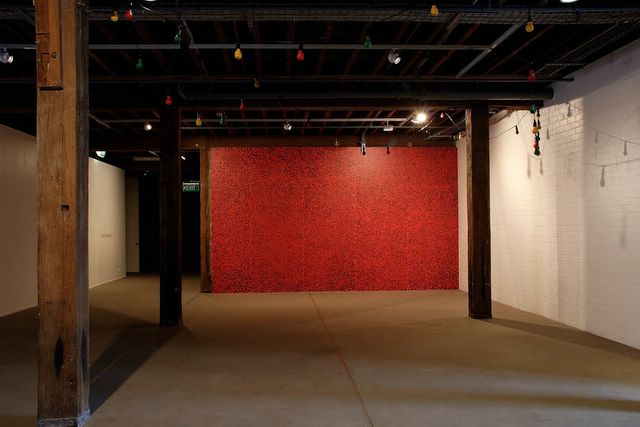
Maria Cruz, One Million Dollars, 2006.
Mixed media, dimesnions variable. Courtesy Artspace.


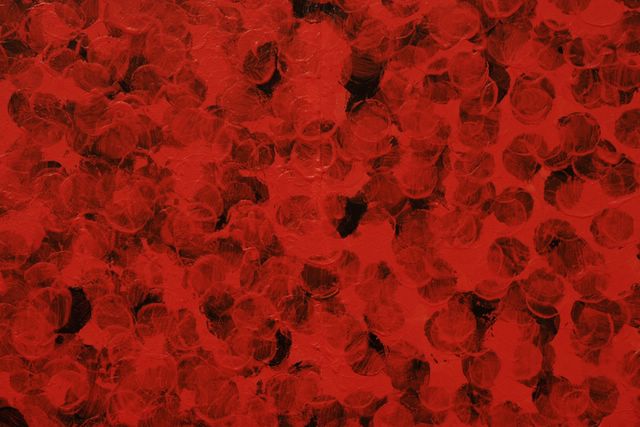
We’re not quite sure how long we have been following Maria Cruz’s work, but it’s been awhile. We had come to accept her appropriation of the career of Yoko Ono, making paintings of all the titles of Ono songs, and then there was a series of paintings she exhibited with Kaliman that had nice decorative bits with text. She is an artist that one must accept does not make ‘pieces’ [to paraphrase Ed Ruscha] but is someone who slowly, over time, explores an idea in incremental steps, little nuanced projects that look bland in isolation but which might add up to something over the long haul. Our problem with this is that we just don’t have the time. Her installation at Artspace is called One Million Dollars in which the artist has attempted to make an impression of a one dollar coin a million times to apparently see what that would look like. Hanging in front of the wall with all the dollar impressions is a string of coloured lights. Only they are not lights, they are facsimiles of lights perhaps made with papier-mâché. With maybe only another 30 or 40 years left to us, we decided to not try to interpret this work and turn to the room notes:

Wealth and currency form the driving imperatives of our society. They may even crystallize our sense of struggle in relation to life and death. One Million Dollars emerges from Maria Cruz's considerations of the social values placed upon money, from hard cash to intangible digital data. As Cruz states, generally speaking, it is hard not to like money. And so this project evolved with the goal of gathering and seeing the impressions one million Australian dollars on a flat surface, in colour. Knowing that what is presented is a recreated and devalued version of One Million Dollars creates an interesting tension with the cultural drive to honour, even worship, and 'value-add' to money as social force.


We agree, it is hard not to like money, especially when you don’t have much of it, and a lot of money in one place would look quite festive. In the case of Cruz’s Artspace install, one million dollars looks a lot like the pattern you used to find in waiting rooms on suburban train stations. Do they call that “scumbling”? But what of the not-lights, the fake string of party lights hanging from the ceiling? Look, we just don’t have the time and we can say with certainty that Cruz’s work “crystallizes our sense of struggle in relation to life and death.” We are all going to die soon so if you have something to say – out with it!

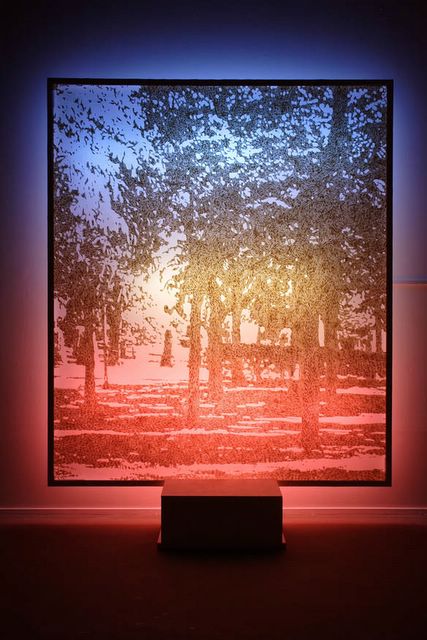
Gary Carsley, D:49 The View of the Chinese Bridge from the Pagado Pavillion at the Nymphenburg, Munich, 2006. 100 x 80 cms (c-type monoprint).
Courtesy TORCH Gallery Amsterdam and Sabine Schmidt Galerie Cologne.


Gary Carsely’s Looking at works of art in the light of other works of art is a punning and verbally dexterous installation of the latest iteration his draguerreotypes. We made comment here of his recent work at Elizabeth Bay House and its over egged presentation making the assumption that a single message was the ideal goal. How wrong can you be? Carsley seems content with making things as complex as possible, layering his ideas in the same way he creates his images from layers and, in an accompanying text, going the route of Saul Bellow by changing tack mid sentence to throw in a new idea. Carsely is also fond of mixing his technology with his cultures and in this show he has created a little platform on which one can perform a shadow dance. The artist encourages visitors to record themselves with their mobile phones and send the results to him at a Youtube address. Maybe, like Cruz’s work, you need to see Carsley’s work over time to really grok what’s going on, but we have decided to surrender to the delirious complexity and enjoy the ride.


Kensuke Todo, Apartment, 2006.
Mild steel, 30x40x28 cms. Courtesy King Street Galleries.


Kensuke Todo is a Japanese artist resident in Sydney and he writes in his catalogue notes for his show at King Street Galleries that his latest body of work is partly a way to deal with his sense of dislocation living in Australia. Like a number of other contemporary artists Todo makes small scale sculptures that quote architectural details in semi abstract sculptures. You’d be forgiven for thinking as you walk through the door of KSG that you may have stumbled into a show of lost Clement Meadmore works, all of it done in sleek soft metals, burnished like bronze, but in fact these are very detailed and miniature worlds awaiting your inspection. The works run from literal renderings of buildings to pieces that look a lot like 60s Minimalist sculptures that, not coincidentally, live in the forecourts of equally minimalist 60s buildings. The sense of completion in Todo’s sculptures is an interesting feature, but one is left to wonder where these details are taken from. Sydney is certainly not a city that has preserved much of this kind of architecture, but we imagine that instead of the literal illustration of the details that trouble Todo, these works are actually metaphorical environments through which the artist and viewer’s imagination may wander..


Marisa Purcell, Arcadia, 2006.
Oil on linen, 182x167cms. Courtesy the artist.


Time Being is the name of Marisa Purcell’s show at United Galleries, a brand new gallery at 179 Palmer Street in East Sydney. [We don’t know if United Galleries have anything to do with United Cellars, the company that uses the flip side of Purcell’s room sheet to advertise Chardonnay, Riesling and Cab Sav, but when we visited the gallery itself we couldn’t get close to some of the work because of all the boxes of booze around the place. The gallery is long, thin, has loads of natural light and is so violently air conditioned it’s like a deep freeze in there]. The last show of Purcell’s we saw was at Kudos Gallery where she was testing out some of her ideas in intimate scale. Her combinations of figuration and abstraction with images of nature and more obscure items were a compelling suggestion that she may have a lot more to discover on her journey. For Time Being she is painting big – up to 182x267 centimeters – and has become more painterly, letting her oil paint wash and drip while letting some of the more definite figuration drift in favour of a dreamy abstraction. We were attracted the works that let the large areas of background colour breathe and the smaller works which had a more definitive, deliberate feel, but there’s something in the unresolved manner in which the larger works hang together that suggest Purcell is an artist still exploring the range of what she’s doing, and that’s always exciting.

Labels: , , ,

Art Life Security Threat

The reason The Art Life is a terrorist target is because the terrorists hate who we are, not because of what we do. We have just been going about our business like we always do, and there has been a lot of business to do over the last couple of weeks. We have been re-jigging our publishing schedule so that our bi-weekly blog updates alternate with our bi-weekly radio show and podcast. Since we posted the first of the podcasts last week we’ve had so many downloads and subscriptions that we’re already number 15 in the iTunes Top 20 Art podcasts. Sign up for the bi-weekly update and, who knows, we may even get to number 1 [with a bullet]. This blog has also recently been nominated the 6th most top art blog in the world. It’s a big honour to be recognised, even if it’s in a site we’ve never heard of - Top Ten Sources - but it’s nice to be loved by some even if the terrorists want to release Sarin Gas into our change room .


We were recently in Newcastle for the This Is Not Art festival, which was actually five festivals under the ‘TINA’ umbrella. After getting back from our appearance with Lily Hibberd and Jeff ‘Wrath of…’ Khan talking about art writing and publishing, we received a mysterious anonymous email asking us if we would please write a review of TINA. We would have loved to have seen enough to write a review but unfortunately TINA was the most shambolically organised event we’ve been involved with. The plan was to go to Newcastle the day before our appearance, go to a few events, attend a cocktail party or two, relax by the beautiful Newcastle foreshore, do our talk, perhaps linger for the rest of the day before heading back to Sydney. Sadly, TINA’s promise of accommodation as an offset for the fact we weren’t being paid to be there never happened due to a complete breakdown in communications between Art Life officers and the TINA people. We never had official confirmation we were speaking at the event and had to rely on the website to confirm we were even on. No one told us where exactly we were speaking, no one gave us any information about venues or details of the city – maps and so on - and the only person from the TINA org we saw was its director Marcus Westbury who dropped by to say hi. Compared to others, we had a good time of it. We heard of some people who had been put up in accommodation right next to a Newcastle nightclub, their hotel walls pounding with disco beats until 5am, and others who arrived from interstate to discover their scheduled appearances were listed in the TINA program as having happened the previous day.

The only thing we saw much of in Newcastle was the inside of the fabulous Goldfarb café and the hundreds of Christian youths cavorting in the park opposite the Newcastle town hall taking part in the festivities of the Jesus Make Us Whole Festival [not affiliated with TINA]. People we met who had been in town for a few days and had got down with the laid back organisational ethos said the fest had some great events. Unfortunately, TEAM Art Life had to pack up our robes, get on the bus and head back down the F1 regretting the fact that we hadn’t demanded at least a free cup of coffee for our troubles. As to the review, we can’t help you, but our friend Lauren at She Sees Red has written an excellent account.

Another story that we’d been following with interest lately has been the sudden and inexplicable change of direction in opinion by our good friend The Esteemed Critic. For those of you who don’t recall, we decided some time ago to have a three month moratorium on any mention of the Sydney Morning Herald’s art critic John McDonald. This was because we were heartily sick of him and by just ignoring his boring, pedestrian and highly predictable reviews we were hoping he would go away. Well, we had been putting so much energy into ignoring him that we ended up actually forgetting about him for awhile, and by not reading his reviews and articles, life started to seem so much brighter and happier. Time passed, weeks turned into months, and now it has been – ooh – six months since we even opened Spectrum to see what he had to say. Two weeks ago we thought, oh go on, have a look – and guess what – things had actually changed.

At the end of last year when the whole brouhaha over the future of the National Art School kicked off, we noted here that when McDonald used his column in the SMH to promote the cause of saving the NAS, he was in no position to claim any objectivity in the matter as he was listed on the NAS website as an employee of the art school. It turned out later that “someone” at NAS had taken it upon themselves to list his name there even though he wasn’t on staff. Our questions about the ethical nature of using a SMH column as a soapbox while claiming to be objective was met with a rather rudely worded email from the Esteemed Critic:

"I've just had this latest piece of paranoia brought to my attention. For the record, I am not employed by the NAS this year. I have given two guest lectures. I've also spoken at CoFA. I have nothing to hide, unlike those who like to sneer and slander others under the cloak of anonymity. This stuff is offensive, it's inaccurate and it's childish."


The game plan at NAS to try to save their bacon and avoid being amalgamated with NSW University’s College of Fine Arts has been to attack COFA as some sort of crazed bastion of post modernity where core values like learning to draw are ignored in favour of pointing a video camera at your jacksie. This strategy worked a treat in the early 90s and NAS had been trying it on again. Never mind that many of NAS staff had actually studied and taught at COFA, or that the NAS’s much vaunted “atelier model’ that’s allegedly in danger of being snuffed out is duplicated in private art schools such as at Julian Ashton’s, in private courses conducted by artists such as Garry Shead and Jason Benjamin, or in government funded institutions such as the Sydney Gallery School - attack COFA, ignore the facts, appeal to some misguided and uniformed notion of NAS’s importance. As we said at the time, if NAS had simply appealed to the art community for support it may have got it but its divisive and dishonest campaign has alienated many of its potential supporters. Increasingly desperate measures such as celebrity art auctions, open letters to the Prime Minister John Howard and appeals in the media have come so far to nothing.


And this, in a round about way, brings us back to The Esteemed Critic. We asked in November 2005 if McDonald would start using his column as a soapbox to support other worthy art world causes - protesting the imposition of Voluntary Student Unionism and the end of student association galleries, newspapers and radio stations for example. Of course, nothing of the sort happened and we knew full well it wouldn’t. Still, it was rather surprising to open Spectrum and finding that McDonald had reviewed Chinese Whispers, a drawing exhibition held at COFA’s Ivan Dougherty Gallery that was curated by Mike Esson, a highly respected artist, teacher and art skills traditionalist who has been at COFA for at least 20 years. McDonald’s preamble to reviewing the show [and another at Ray Hughes Gallery] was actually longer than the time spent on discussing the art, going through the back story of the NAS battle. Then this:

“I am an unashamed partisan of the independent National Art School, along with a large and diverse group of people, including Margaret Olley, John Olsen and the Crown Prosecutor, Mark Tedeschi…”


Finally, an admission of the bleeding obvious. McDonald then raised the spectre of voting for Peter Debnam as the Liberals are the only party willing to commit to saving NAS. Ahem. This being a review of sorts, McDonald then moved onto to discussing the IDG show. Although rather long, we’re going to quote most of McDonald’s column below as you can see in it the twists and turns of logic [combined with patented EC insults and barbs] all of it ending up at a very surprising place:

“Among the more contentious issues between the two institutions is the question of the teaching of drawing. Since its rebirth in 1996, the National Art School has made drawing the foundation of its educational platform. Every student is expected to draw, no matter what their specialisation, and no one has ever suffered or had their creativity ruined by acquiring these drawing skills. It is a common boast at the school that College of Fine Arts students come to them as postgraduates in order to learn how to draw. Perhaps this is the kind of barb to which curator Mike Esson is responding in the catalogue of the exhibition Chinese Whispers at the college's Ivan Dougherty Gallery. “The College of Fine Arts has always maintained a strong commitment to drawing,” he writes. "It has been COFA's intent, not to be prescriptive, and not to teach students how to draw, but to teach them how to learn to draw, and to see drawing within a wider artistic and cultural context."

“This may seem a very fine distinction, but it hints at the differences between the schools. The college prides itself on a more "pluralistic" approach, with a greater emphasis on new technologies. The National Art School clings doggedly to tradition, believing that basic drawing skills should precede any experiments with new media. Esson, having stated the college's case with some precision, goes on to concede that all the artists in the exhibition work with the traditional media of pencil or charcoal on paper. This may be one of the reasons that Chinese Whispers is such an impressive show.

“All of the artists are recent masters or doctorate graduates from the College of Fine Arts. Most of them have also studied at other institutions, including the National Art School. They are mature artists with numerous exhibitions behind them, not raw beginners.The variety of approaches and subjects makes this exhibition a fascinating compendium of drawing styles, from Maria Kontis's exquisite, pale pastels based on snapshots, to the Zen-influenced abstractions of Toshiko Oiyama and the expressionism of Deborah Wilkinson. Nicola Brown portrays herself in the guise of a battalion of toy soldiers; Amanda Robins draws elaborate swathes of fabric, as a cypher for the body. Muamer Cajic and Li Wenmin are explorers of physical and mental space -from rooms and buildings to the frontiers of memory.

“With the exception of Li Wenmin, there is nothing especially Chinese about this show. It may simply be that Esson, who now bears the august title "director, International Drawing Research Institute" (a college research group with ties to colleges in Beijing and Glasgow), has been to China so many times in the past few years that he has China on the brain. In fact, Esson and that other frequent flyer, the college's director, Ian Howard, a have virtually established themselves as a two-man institute of Sino-Australian relations. How much more impressive would it sound to their Chinese peers if they could stick "National Art School" on their business cards?

“Ultimately there is no reason to believe the college is anti-drawing. In Esson and Idris Murphy, at the very least, they have two highly dedicated draftsmen. Perhaps the simmering tension between the institutions could be defused by a straightforward policy of live and let live. Along with the third alternative of the Sydney College of the Arts, there is room for three very different art schools in metropolitan Sydney. It should be obvious that with any creative activity, a greater number of educational options creates a more vital and productive environment. That's enough about the art school debate. In a perfect world I could forget about the art politics and concentrate on exhibitions.”


By ignoring the colloquial meaning of the term “Chinese whispers” McDonald gives himself the perfect opportunity to take a cheap shot at COFA’s pragmatic engagement with Chinese artists and, of course, their full fee paying International students without whom NSW Uni would be in deep financial trouble. The bigger issue of chronic under funding by the Feds, VSU-imposed cultural desolation of tertiary institutions, not to mention the complete isolation NAS has enjoyed due to their Shangri-La style funding arrangement with the state, are all left unaddressed here. You have to wonder why the Esteemed Critic, after all this time, has finally admitted on the one hand he is a NAS partisan, and on the other, conceding the very arguments that he himself has put forward are utter rubbish. He writes as though he is reporting someone else’s argument when it was he in the pages of the SMH who claimed only NAS taught drawing 'properly'.

It is interesting to speculate on which pressing issue in the art world that McDonald will next turn his prodigious writerly skills to supporting. With NAS now as good as dead and all those famous people moving on, he might like to consider the plight of the University of Western Sydney who are being forced to axe three of its key arts programs - Fine Arts, Electronic Arts and Performance. Students, staff and alumni are publishing a blog to gather support for saving UWS and have managed to get their story into the Herald. Thus far, however, the Esteemed Critic remains silent.

Labels: , , ,

Dance This Mess Around

Monday, October 09, 2006

Click me


Duke Magazine is holding it’s next fundraiser, 'The Ultimate Dance-Off of all Time' Friday 20th October at Lan Franchi’s. With a panel of judges, Dj’s and prizes for Solos and Partners, this is a night you won’t want to miss. Come and support Duke magazine and show off your dancing skills. The competition will end with two people dancing off before the crowd. All proceeds from the event go towards printing and distribution costs of Duke Magazine.

*


Click me


*


MOP
12 October - 29 October 2006
opening Thursday 12.10.06 6 - 8 pm


Reuben Keehan, Proun 8B (for the decomposition of the old modes of communication and the search for new languages capable of articulating this), 2006.


LOW a low shelf, low down, to lay one low, Low countries, low ground, low necked, low walls, low relief, low tide, a low number, low latitude, low calorie diet, a a low estimate of something, low spirits, low birth, a low type of intellect, lie low, a low trick, low company, low vibrations, a low murmur, low church, a low level, low transmission gear ratio, a low position, in a low tone, low - pressure, the lowest trump card, an all time low, low area, low born, low boy, low bred, low brow, low cloud, low comedy, lower, lower case, lower chamber, lower class, lower deck, lower house, lowering, lowermost, lower world, lowest common denominator, lowest common multiple, low explosive, low frequency, low german, low - life, low grade, low heel, low - key, low land, low latin, low - level language, low - level violence, low loader, lowly, lowliness, low mass, low minded, low pass filter, low pitched,low profile, low relief, low rise, lowly, low season, low sunday, low - tension, low tide, low - voltage, low water, low week, low wine, low resonance, low and behold.

LOW
Andrew Best, Grant Stevens, Ms & Mr, Reuben Keehan, Todd McMillan.
organised: George + Ron Adams


MOP Projects Room 16 / 617 Elizabeth Street Redfern 2016 Sydney Australia www.mop.org.au mop@mop.org.au

Labels: ,

Art Life Podcast Episode #1

Wednesday, October 04, 2006

Click here to get your own player.


...in which we discuss exhibitions by Tim Storrier at Sherman Galleries, his dog, the desert and the mongrel; Noel McKenna at Darren Knight Gallery, his walks through Sydney, maps and memorials to memory; Lee Scratch Perry's Version A; Primavera at the Museum of Contemporary Art, curator Aaron Seeto, decorated potatoes etc; what's opening this week in exhibitions around the world; DJ Nesbitt's mash up of David Essex and the Heroes of Tuva.

Subscribe to The Art Life Podcast. There are three easy ways to listen to our bi-weekly chat with Eastside Radio's Sean O'Brien...

[1] You can simply listen to a live stream by pressing the play button. Sit back and enjoy the chat and the tunes.

[2] You can go to The Art Life's podcast homepage and then hit download. You can then save the podcast for later listening pleasure.

[3] Subscribe via iTunes. We are now listed in iTunes Music Store. The simplest means of subscribing is to go directly to the Art Life Podcast page and subscribe. [When you click on this link, iTunes should launch on your computer. If not, open it, then click on the link again...]

I can't hear anything! There are two possible problems here. Most likely, you don't have the appropriate settings on your computer, you don't have iTunes, or there's a gremlin in the works. If you're sure it's not your computer's fault, email us... The other likely cause is that we have exceeded our Podomatic bandwidth. In which case, try again after October 6th when we will be Pro.

Labels: , , ,