This Then Is What Happened
Tuesday, December 20, 2005
It’s estimated by Technorati that there will be more than 28 million blogs online at the end of this month. Of all of those started up with a ton of enthusiastic optimism fewer than 50 per cent are still going six months later. Of those, less than five per cent survive longer than two years. In February, The Art Life will be two years old and if we’ve done nothing else, we have at least beaten the odds.
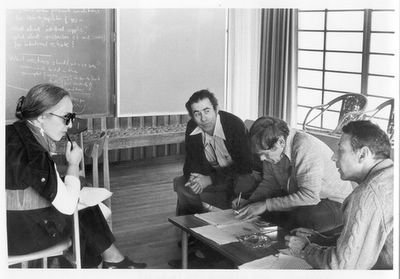
The Art Life team plan 2006's new style blog.
Last year we offered our readers a Solid Gold Guarantee™ and we’ve been asked what we intend to do for this New Year. The answer is simply that we’re coming back for our third year, perhaps in a form a little different to what we are now, but we’ll definitely be back. And you can take that guarantee to the bank! In another new tradition where we celebrate Festivus [“a holiday for the rest of us”], it’s time for us to take stock of 2005 and what we saw, what we did, who we defamed, what we got right and what we got wrong.
The last couple of weeks have been a punishing time for those who believe in social justice. It’s been a long, long decade and it looks like its going to get a whole lot worse before it gets any better. Two weeks ago, just after the execution of Van Nguyen in Singapore, we asked our readers to consider the ethics of working as exhibiting artists and if readers could extend their practical, personal concerns to wider political and ethical considerations – namely, would exhibiting in a country that is undemocratic, repressive and uses the death penalty as a means of social control be a good place to show their gouaches? The answer, such as it was, disappointingly descended into entrenched attitudes – some readers couldn’t see beyond their own immediate concerns or they resorted to default attitudes about our Asian neighbours. Some readers did take the question seriously but on the whole it didn’t take much to provoke a predictable response.
On the other hand, could it have been any different? In the last week we have seen the ugliest aspects of Australian society surface in the full sight of the international media. Instead of acknowledging that there are racist elements in this country [which are in part a result of a failure to even acknowledge that they exist], we have seen Premier Iemma, a hand puppet of the conservative Labor right, start blaming the victims with talk of “urban terrorists” and the police using inflammatory language with terms such as “credible threat” conflating what is simply an issue of law and order with the War on Terror. Oh yes, and the media is to blame… The Art Life may not be the place for serious discussion – even just once in a while – but then again, neither is the rest of the country.
The last day of sitting of the Senate of the Federal Government for 2005 saw the passing of the Voluntary Student Unionism Bill. While it seemed that Nationals Senator Barnaby Joyce would block it, the Government did a back room deal with right religious conservative Family First senator Steven Fielding. The Fed’s leverage with Fielding was a deal to block the introduction of the RU 486 abortion pill, a non deal if there ever was one. The RU 486 pill isn’t even available in Australia, but the deal is now that it never will be. For this illusory victory, Fielding has helped the Federal Government strip university student unions of the right to compulsorily levy a fee for services. While it’s conceivable that some University union services will be taken over by private enterprise – and the real reason for the VSU bill in the first place – others will not. There’ll be a demand for some health services, gyms, crèches and bars, and maybe even some of these mollusk-like small businesses will operate at a profit – but the cultural life of universities will be damaged as student galleries, newspapers and radio stations will be forced to close. In Sydney we can say goodbye to Kudos Gallery, Sir Herman Black Gallery and Newspace.
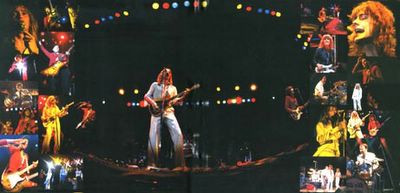
Art Life: Triple Live at Budokan, October 2005.
This is all small potatoes compared to those euphemistically named bills such as the Unfair Dismissal Bill, which makes it easier to dismiss someone unfairly, The Workplace Relations Bill, which makes employee/employer relations one-sided, or the Anti-Terrorism Bill, which makes it easier to criminalise political dissent and thus create more terrorists. These bills have all passed into law. There have been some exceptions to the rule that the art world doesn’t give a toss about anything but itself - exhibitions such as MOP Projects show protesting the sedition laws in the Anti-Terrorism Bill and articles by Joanna Mendelssohn in New Matilda joined similar protests by journalists, writers, actors and the film industry. Unfortunately, these protests have come to naught as the Federal Government has had each and everyone of its bills passed in time for Christmas.
It has been said by some of our readers that we are either apolitical or the art world equivalent of Alan Jones. We had the temerity to say that an artist who uses a super expensive flat screen TV to show a video of anti-globalism protests ought to think about the way in which their art is being framed, literally and metaphorically, but apparently that makes us the same as Ray Hadley. We can ask our readers to talk about their ethical world view and we are called apolitical. We talk about politics, and we have our own political views, it’s just that The Art Life team doesn’t choose to wear our hearts on our sleeves on a regular basis. We talk about the art world, the politics of the art world and how the wider world impacts on it – we’d say that was a ‘political’ view… And that is why we suggest the following: the VSU bill has been passed and until it is repealed [an unlikely event] maybe the commercial galleries, or even the Australian Commercial Galleries Association, might like to donate money directly to student unions to help towards the operation of student galleries? It makes sense. If Dr. Gene and Brian Sherman can see their way clear to donate money to the Power Institute at Sydney University to build a reading room, then maybe Tim Olsen or Vasili Kaliman or James Draper or Stephen Grant or Roslyn Oxley or someone can throw in $10k to the student union at Sydney College of the Arts or the College of Fine Arts or the National Art School – they’ll be showing their artists soon enough… and student unions - make yourselves registered charities now!
Perhaps everything in the art world gets boiled down to personalities – at least our readers think so. We receive a lot of gossip via email telling us all sorts of amazing things about people we know but we choose not to publish it – not because we are principled, oh no, but because we’d have our collective arses sued from here to Sunday. A lot of the best stuff we can’t publish – there’s an amazing story, for example, about two well known art world identities who are currently in litigation. We were approached with the tantalizing details of the stoush with the promise that it was all legally fine and dandy and just as we were about to go public we received an email saying “NO DON’T!!!” C’est la vie.
We got a few things wrong this year. Some were matters of opinion, others were matters of fact. There were shows we didn’t review properly. For example, we didn’t do a very good job reviewing Scott Redford’s work at the Art Gallery of NSW show Unscripted. Why? We fear Scott Redford. We said as much in the review but in truth we just didn’t get the work and anticipated the wrath. We didn’t do a great job on Primavera either, with most responses from readers being overwhelmingly thumbs down, and we wish we had been a bit more on the ball with Situation at the Museum of Contemporary Art. We blanched when it came to some shows by some well known artists in commercial galleries that we just couldn’t bring ourselves to review – being too negative all the time takes its toll, and sometimes artists deserve the benefit of the doubt.
Then there were matters of fact. We stated that John McDonald was an employee of the National Art School and that was incorrect. We had based that statement on the fact that his name was included on the National Art School’s web site list of employees – but that was some sort of administrative error. Our mistake. McDonald protested his innocence and we should have realised at that point that he wasn’t compromised by some sort of economic or philosophical alliance with the NAS, but rather he was campaigning for the rights of students to be educated in any way they see fit. We look forward to the Esteemed Critic’s campaign in support of the abolition of the VSU bill. Speaking of critics, we recently met Peter Hill, [the bloke who had McDonald’s job after the Sydney Morning Herald didn’t have an art critic for two years after Sebastian Smee went overseas and Bruce James threw in the towel for a job at the ABC]… We were dreading it – we had ripped the hell out of Hill for nearly a year and we were a little nervous at the prospect of meeting him faces to face. It turned out Hill either didn’t know or care about us and proved to be exactly in person as he seems to be in print, that is, a charming duffer with a wandering mind and a love of lighthouses.
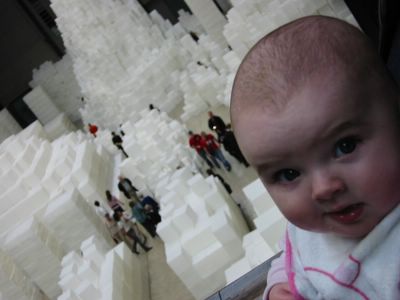
The Art Life on tour 2005.
You will have noticed that we rarely bother to review the reviewers anymore. We often agree with McDonald and it makes us feel all weird inside because at other times he reverts back to type. Last week’s review of Erwin Wurm and Jacky Redgate at the MCA centered its main criticism on the claim that all this conceptual art has been done before [and not better, just before] ignoring the fact that nearly all art has been done before. McDonald looked like he was about to open the Pandora’s Box labeled “originality” but eventually he just ignored it. His one time protégé Sebastian Smee over at The Australian is, in the words of one Art Life reader, “at least trying” and we should acknowledge the effort. Smee didn’t think much of Primavera 2005 and he was right, it was arse. Most other weeks, however, Smee drifts through a rarified world of old masters and musty museum paintings, wrestling with the big questions of aesthetic appreciation and marvelous revelations courtesy of early Modernists. While in London in October, we paused at the entrance of the exhibition Degas, Sickert and Toulouse-Lautrec at the Tate Britain and thought for a moment of going in. Then we thought, we’re not Sebastian Smee! Unsurprisingly perhaps, Smee himself was there at the exact same moment as our party, later filing a wonderfully thoughtful piece from London for the folks back home.
Some people have asked us over the last year why we don’t write for The Australian or The Sydney Morning Herald ourselves [if we’re so smart!] – and believe us, it’s not for the want of trying. The truth is we just don’t have the connections or understand the politics of Fairfax or News Limited. Take Nicolas Rothwell for example. Last year Rothwell, writing in The Australian, decried the paucity of critical writing on Indigenous art and wondered where all the art critics were who could tackle the subject. He suggested John McDonald as a possible nominee but forgot that Macca hates flying in small aircraft or traveling on bumpy roads while completely ignoring Susan McCulloch, a writer with a detailed understanding of the art of Indigenous peoples. We incorrectly assumed that Rothwell was promoting his just published book on Indigenous art [and he may have well been doing so] but the nomination of McDonald was a head scratcher. It turns out that the piece was actually an extended job application – Rothwell is now The Australian’s Indigenous art correspondent. See, that’s how it’s done – you write a piece about your area of expertise decrying the lack of expertise and just sit back and wait for the phone to ring. You don’t go starting email campaigns to The Metro demanding that they save their visual arts coverage, you don’t write back to the editor of said section when they have a go at you for your “great services to journalism” demanding an explanation, you don’t go on radio saying the arts editor of the SMH [whoever it is this month] should be bloody shot for doing such a shit job. No, don’t do that. That’d be career suicide.
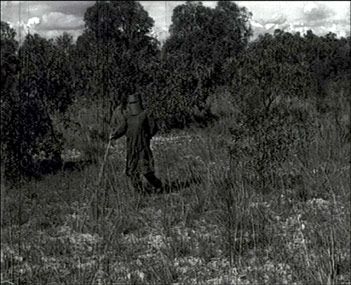
Derek Kreckler, Blind Ned, 1998. Single channel DVD.
Courtesy of the artist.
There were some great shows this year, many of which we tried to review, others that we simply couldn’t get to. Among the really good shows was Derek Kreckler’s Downstairs at the Performance Space. We kept thinking, next week, next week, and then when we got around to it, it was over. The last year at the Performance Space has seen some excellent, extensive one person shows – Tony Schwensen’s solo outing at the start of the naffly named Who’s Afraid of The Avant Garde series springs to mind – and Kreckler’s show was a beauty. Someone commented recently about the work of David Haines that they just didn’t get it, that whatever it was supposed to be “about” eluded them. They might well say the same for Kreckler’s work because, like Haines, it deals with associative meanings and poetic readings for its impact. A big six channel DVD installation called Antidote presented views of a waterfall, water slowly falling at various speeds, the sound of the crashing reverberating around the room. It was landscape, pure and simple, but somehow the work also evoked the history of landscape photography and cinematic spaces, dicing up the outside for our indoor pleasures. It was camera obscura meets DV Cam. Another work in the show, Blind Ned, purported to show ancient film of Ned Kelly in armour walking through bush with a blind man’s cane. It was so simple, yet so rich, it was difficult to know where to start. If all else failed, you could just feel the work, and it was amazing.
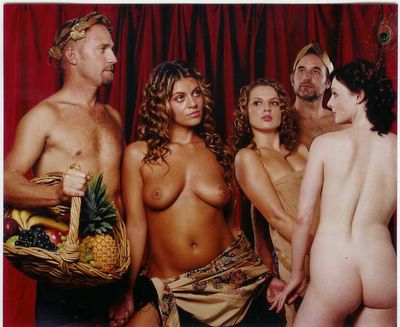
Magdalena Wozniak, Untitled no.2 (after Spring's Innocence), 2005.
Cibachrome print, edition of 5, 73 x 88 cm.
Courtesy Liverpool Street Gallery.
Other shows we saw we couldn’t review because words deserted us. Magdalena Wozniak’s show at Liverpool Street Gallery left us speechless. Using big sumptuous photographic prints, the artist recreated some key images from Norman Lindsay’s body of work. In Wozniak’s photographs you’re not thinking about Dionysian trysts in bush land, but rather what the woman in the centre of Untitled no.2 (after Spring’s Innocence) is saying - bring me another Cock Sucking Cowboy?
There were so many shows, so many things to see, we just couldn’t seem them all. In 2006, we vow to do more, yet less. The success of The Art Life has actually left us with a lot less time to do The Art Life, and we propose for the next year a new model. It will be unveiled in its full glory when we return in mid-January, fully refreshed and ready for the fight. Seasons greetings!

The Art Life team plan 2006's new style blog.
Last year we offered our readers a Solid Gold Guarantee™ and we’ve been asked what we intend to do for this New Year. The answer is simply that we’re coming back for our third year, perhaps in a form a little different to what we are now, but we’ll definitely be back. And you can take that guarantee to the bank! In another new tradition where we celebrate Festivus [“a holiday for the rest of us”], it’s time for us to take stock of 2005 and what we saw, what we did, who we defamed, what we got right and what we got wrong.
The last couple of weeks have been a punishing time for those who believe in social justice. It’s been a long, long decade and it looks like its going to get a whole lot worse before it gets any better. Two weeks ago, just after the execution of Van Nguyen in Singapore, we asked our readers to consider the ethics of working as exhibiting artists and if readers could extend their practical, personal concerns to wider political and ethical considerations – namely, would exhibiting in a country that is undemocratic, repressive and uses the death penalty as a means of social control be a good place to show their gouaches? The answer, such as it was, disappointingly descended into entrenched attitudes – some readers couldn’t see beyond their own immediate concerns or they resorted to default attitudes about our Asian neighbours. Some readers did take the question seriously but on the whole it didn’t take much to provoke a predictable response.
On the other hand, could it have been any different? In the last week we have seen the ugliest aspects of Australian society surface in the full sight of the international media. Instead of acknowledging that there are racist elements in this country [which are in part a result of a failure to even acknowledge that they exist], we have seen Premier Iemma, a hand puppet of the conservative Labor right, start blaming the victims with talk of “urban terrorists” and the police using inflammatory language with terms such as “credible threat” conflating what is simply an issue of law and order with the War on Terror. Oh yes, and the media is to blame… The Art Life may not be the place for serious discussion – even just once in a while – but then again, neither is the rest of the country.
The last day of sitting of the Senate of the Federal Government for 2005 saw the passing of the Voluntary Student Unionism Bill. While it seemed that Nationals Senator Barnaby Joyce would block it, the Government did a back room deal with right religious conservative Family First senator Steven Fielding. The Fed’s leverage with Fielding was a deal to block the introduction of the RU 486 abortion pill, a non deal if there ever was one. The RU 486 pill isn’t even available in Australia, but the deal is now that it never will be. For this illusory victory, Fielding has helped the Federal Government strip university student unions of the right to compulsorily levy a fee for services. While it’s conceivable that some University union services will be taken over by private enterprise – and the real reason for the VSU bill in the first place – others will not. There’ll be a demand for some health services, gyms, crèches and bars, and maybe even some of these mollusk-like small businesses will operate at a profit – but the cultural life of universities will be damaged as student galleries, newspapers and radio stations will be forced to close. In Sydney we can say goodbye to Kudos Gallery, Sir Herman Black Gallery and Newspace.

Art Life: Triple Live at Budokan, October 2005.
This is all small potatoes compared to those euphemistically named bills such as the Unfair Dismissal Bill, which makes it easier to dismiss someone unfairly, The Workplace Relations Bill, which makes employee/employer relations one-sided, or the Anti-Terrorism Bill, which makes it easier to criminalise political dissent and thus create more terrorists. These bills have all passed into law. There have been some exceptions to the rule that the art world doesn’t give a toss about anything but itself - exhibitions such as MOP Projects show protesting the sedition laws in the Anti-Terrorism Bill and articles by Joanna Mendelssohn in New Matilda joined similar protests by journalists, writers, actors and the film industry. Unfortunately, these protests have come to naught as the Federal Government has had each and everyone of its bills passed in time for Christmas.
It has been said by some of our readers that we are either apolitical or the art world equivalent of Alan Jones. We had the temerity to say that an artist who uses a super expensive flat screen TV to show a video of anti-globalism protests ought to think about the way in which their art is being framed, literally and metaphorically, but apparently that makes us the same as Ray Hadley. We can ask our readers to talk about their ethical world view and we are called apolitical. We talk about politics, and we have our own political views, it’s just that The Art Life team doesn’t choose to wear our hearts on our sleeves on a regular basis. We talk about the art world, the politics of the art world and how the wider world impacts on it – we’d say that was a ‘political’ view… And that is why we suggest the following: the VSU bill has been passed and until it is repealed [an unlikely event] maybe the commercial galleries, or even the Australian Commercial Galleries Association, might like to donate money directly to student unions to help towards the operation of student galleries? It makes sense. If Dr. Gene and Brian Sherman can see their way clear to donate money to the Power Institute at Sydney University to build a reading room, then maybe Tim Olsen or Vasili Kaliman or James Draper or Stephen Grant or Roslyn Oxley or someone can throw in $10k to the student union at Sydney College of the Arts or the College of Fine Arts or the National Art School – they’ll be showing their artists soon enough… and student unions - make yourselves registered charities now!
Perhaps everything in the art world gets boiled down to personalities – at least our readers think so. We receive a lot of gossip via email telling us all sorts of amazing things about people we know but we choose not to publish it – not because we are principled, oh no, but because we’d have our collective arses sued from here to Sunday. A lot of the best stuff we can’t publish – there’s an amazing story, for example, about two well known art world identities who are currently in litigation. We were approached with the tantalizing details of the stoush with the promise that it was all legally fine and dandy and just as we were about to go public we received an email saying “NO DON’T!!!” C’est la vie.
We got a few things wrong this year. Some were matters of opinion, others were matters of fact. There were shows we didn’t review properly. For example, we didn’t do a very good job reviewing Scott Redford’s work at the Art Gallery of NSW show Unscripted. Why? We fear Scott Redford. We said as much in the review but in truth we just didn’t get the work and anticipated the wrath. We didn’t do a great job on Primavera either, with most responses from readers being overwhelmingly thumbs down, and we wish we had been a bit more on the ball with Situation at the Museum of Contemporary Art. We blanched when it came to some shows by some well known artists in commercial galleries that we just couldn’t bring ourselves to review – being too negative all the time takes its toll, and sometimes artists deserve the benefit of the doubt.
Then there were matters of fact. We stated that John McDonald was an employee of the National Art School and that was incorrect. We had based that statement on the fact that his name was included on the National Art School’s web site list of employees – but that was some sort of administrative error. Our mistake. McDonald protested his innocence and we should have realised at that point that he wasn’t compromised by some sort of economic or philosophical alliance with the NAS, but rather he was campaigning for the rights of students to be educated in any way they see fit. We look forward to the Esteemed Critic’s campaign in support of the abolition of the VSU bill. Speaking of critics, we recently met Peter Hill, [the bloke who had McDonald’s job after the Sydney Morning Herald didn’t have an art critic for two years after Sebastian Smee went overseas and Bruce James threw in the towel for a job at the ABC]… We were dreading it – we had ripped the hell out of Hill for nearly a year and we were a little nervous at the prospect of meeting him faces to face. It turned out Hill either didn’t know or care about us and proved to be exactly in person as he seems to be in print, that is, a charming duffer with a wandering mind and a love of lighthouses.

The Art Life on tour 2005.
You will have noticed that we rarely bother to review the reviewers anymore. We often agree with McDonald and it makes us feel all weird inside because at other times he reverts back to type. Last week’s review of Erwin Wurm and Jacky Redgate at the MCA centered its main criticism on the claim that all this conceptual art has been done before [and not better, just before] ignoring the fact that nearly all art has been done before. McDonald looked like he was about to open the Pandora’s Box labeled “originality” but eventually he just ignored it. His one time protégé Sebastian Smee over at The Australian is, in the words of one Art Life reader, “at least trying” and we should acknowledge the effort. Smee didn’t think much of Primavera 2005 and he was right, it was arse. Most other weeks, however, Smee drifts through a rarified world of old masters and musty museum paintings, wrestling with the big questions of aesthetic appreciation and marvelous revelations courtesy of early Modernists. While in London in October, we paused at the entrance of the exhibition Degas, Sickert and Toulouse-Lautrec at the Tate Britain and thought for a moment of going in. Then we thought, we’re not Sebastian Smee! Unsurprisingly perhaps, Smee himself was there at the exact same moment as our party, later filing a wonderfully thoughtful piece from London for the folks back home.
Some people have asked us over the last year why we don’t write for The Australian or The Sydney Morning Herald ourselves [if we’re so smart!] – and believe us, it’s not for the want of trying. The truth is we just don’t have the connections or understand the politics of Fairfax or News Limited. Take Nicolas Rothwell for example. Last year Rothwell, writing in The Australian, decried the paucity of critical writing on Indigenous art and wondered where all the art critics were who could tackle the subject. He suggested John McDonald as a possible nominee but forgot that Macca hates flying in small aircraft or traveling on bumpy roads while completely ignoring Susan McCulloch, a writer with a detailed understanding of the art of Indigenous peoples. We incorrectly assumed that Rothwell was promoting his just published book on Indigenous art [and he may have well been doing so] but the nomination of McDonald was a head scratcher. It turns out that the piece was actually an extended job application – Rothwell is now The Australian’s Indigenous art correspondent. See, that’s how it’s done – you write a piece about your area of expertise decrying the lack of expertise and just sit back and wait for the phone to ring. You don’t go starting email campaigns to The Metro demanding that they save their visual arts coverage, you don’t write back to the editor of said section when they have a go at you for your “great services to journalism” demanding an explanation, you don’t go on radio saying the arts editor of the SMH [whoever it is this month] should be bloody shot for doing such a shit job. No, don’t do that. That’d be career suicide.

Derek Kreckler, Blind Ned, 1998. Single channel DVD.
Courtesy of the artist.
There were some great shows this year, many of which we tried to review, others that we simply couldn’t get to. Among the really good shows was Derek Kreckler’s Downstairs at the Performance Space. We kept thinking, next week, next week, and then when we got around to it, it was over. The last year at the Performance Space has seen some excellent, extensive one person shows – Tony Schwensen’s solo outing at the start of the naffly named Who’s Afraid of The Avant Garde series springs to mind – and Kreckler’s show was a beauty. Someone commented recently about the work of David Haines that they just didn’t get it, that whatever it was supposed to be “about” eluded them. They might well say the same for Kreckler’s work because, like Haines, it deals with associative meanings and poetic readings for its impact. A big six channel DVD installation called Antidote presented views of a waterfall, water slowly falling at various speeds, the sound of the crashing reverberating around the room. It was landscape, pure and simple, but somehow the work also evoked the history of landscape photography and cinematic spaces, dicing up the outside for our indoor pleasures. It was camera obscura meets DV Cam. Another work in the show, Blind Ned, purported to show ancient film of Ned Kelly in armour walking through bush with a blind man’s cane. It was so simple, yet so rich, it was difficult to know where to start. If all else failed, you could just feel the work, and it was amazing.

Magdalena Wozniak, Untitled no.2 (after Spring's Innocence), 2005.
Cibachrome print, edition of 5, 73 x 88 cm.
Courtesy Liverpool Street Gallery.
Other shows we saw we couldn’t review because words deserted us. Magdalena Wozniak’s show at Liverpool Street Gallery left us speechless. Using big sumptuous photographic prints, the artist recreated some key images from Norman Lindsay’s body of work. In Wozniak’s photographs you’re not thinking about Dionysian trysts in bush land, but rather what the woman in the centre of Untitled no.2 (after Spring’s Innocence) is saying - bring me another Cock Sucking Cowboy?
There were so many shows, so many things to see, we just couldn’t seem them all. In 2006, we vow to do more, yet less. The success of The Art Life has actually left us with a lot less time to do The Art Life, and we propose for the next year a new model. It will be unveiled in its full glory when we return in mid-January, fully refreshed and ready for the fight. Seasons greetings!


