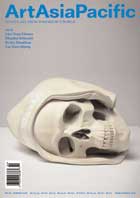
The collapse of
Craftsman House saw the sale of its two prime mastheads,
Art Asia Pacific and
Art & Australia . AAP went offshore to New York while
Art & Australia stayed at home. With both magazines now out with relaunch issues, it makes for interesting comparative reading.
The new
Art Asia Pacific,if only on the evidence of its first issue, is simply terrible. Reading more like a student effort and featuring obvious choices like
Takashi Murikami (issue one cover) and
Yoshitomo Narra (on the cover of issue two), the text is double spaced to take up more room and the writing is decidedly amatuerish.
Interestingly, the new publisher,
Gang Zhao, has an eclectic range of Australian contributors including
Felicity Fenner, ‘editor-at-large’
Adam Geczy and
Charles Merewether. Even more curiouser is the inclusion on the masthead of “Associate Editor
Benjamin Gennochio", former art critic for
The Australian and partner to the recently relocated
Melissa Chiu, herself a former contributor and guest editor at AAP, former director of
Gallery 4A and now the toast of
New York It’s good to see that all bridges haven't been burnt.
A&A, meanwhile, was sold to new publisher
Eleonora Triguboff who drafted in the services of former AAP editorial assistant
Claire Armstrong as the new editor.
Judging by their first efforts, it’s business as usual at the longest running art magazine in the country. With a slight design rejig and a new logo (lower case art, upper case Australia, ampersand & in-between) the latest edition has a handsome cover by
Cherry Hood. Inside, academic articles on artists, some reviews, boring book reviews (by the insufferable
Andrea Stretton) and advertising by the good, the bad and the
fugly of the Australian gallery scene.
In her first editor’s letter, Armstrong informs her readers that the new A&A will continue the grand tradition of the Australian art world’s
“journal of record”.At a time when much visual arts writing is focused on the monetary value of art, Art & Australia is dedicated to publishing rigorous, informed essays, articles about art that engages, inspires, overwhelms, challenges and provokes…
What an odd thing to say –
“focused on the monetary value of art” ? Whatever can she mean? Especially when the magazine carries a 12 page section dedicated to the art market with collector profiles, articles by art market veteran
Terry Ingram and another one of
Roger Dedman’s insightful analyses of the secondary market?
The fact that is being skirted here is that A&A has been in strife ever since the arrival of
Australian Art Collector onto the art magazine publishing scene. Slicing up the already limited art advertising dollar meant that the two magazines would inevitably go head to head.
A&A blinked first, introducing collector profiles as AAC’s hold on the advertising dollar started to tell, and the venerable institution tried to lure back many readers who had only ever been buying A&A for the pictures. It cost them a talented editor too,
Hanna Fink reportedly resigning rather than stoop to copying AAC’s formula. Sadly for A&A, their parent company Craftsman House was already on the chopping block, outstanding writer’s fees making for juicy art world gossip stories in the
Sydney Morning Herald (here's a good
example of their woes, reported back in 2002 when
Rhonda Fitzsimmons bought Craftsman House and Fine Art Press.)
While we’re totally in support of A&A and hope for them nothing but the best (it being the journal of record and all), we can’t help but wonder if this isn't going to end in tears – from a purely pragmatic business point of view, isn’t the ‘new’ format just a repeat of the very format that lost Craftsman House money? And while we’re asking the tough questions, isn’t it just a little disingenuous to suggest that rival magazines are “focused on the monetary value of art” when they are doing exactly that in their art market section? Just because you hive off the mention of dirty commerce to a 12 page section printed on different coloured paper – away from all the apparently ‘proper’ writing on art – doesn’t mean that you aren’t actually doing it
yourself.
Anyway, we wish them luck.
Labels: art magazines, art market, art politics